
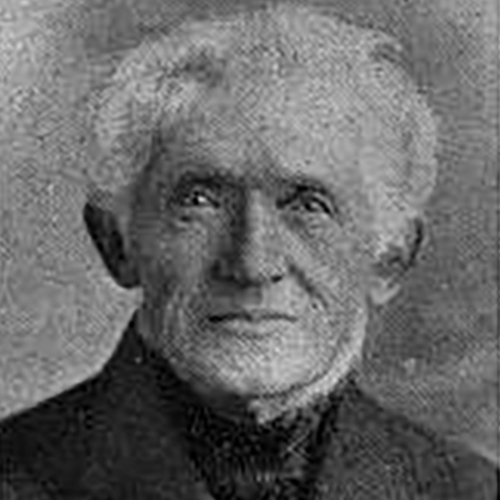
Enos Piercy
Few individuals embody the continuity of nineteenth-century Rillington as completely as Enos Piercy. Although remembered principally as parish clerk and sexton, he was also a tailor, property owner, husband, father, grandfather and one of the village’s most enduring figures.
Baptised on 2 November 1823, the son of Mary Piercy, spinster, Enos lived through a period of extraordinary change. He witnessed Rillington before the arrival of the railway, saw the coming of the York and North Midland Railway in 1845, and lived long enough to experience the Edwardian era. Yet throughout these transformations he remained a constant presence within parish life.
On 20 March 1847 he married Elizabeth Simpson at St Andrew’s Church, Rillington. The marriage certificate records Enos as a bachelor of full age, resident in Rillington and employed as a Parish Clerk. Elizabeth Simpson, also resident in Rillington, was described as a milliner, the daughter of Joseph Simpson, blacksmith. The certificate demonstrates that by 1847 Enos had already assumed the office that would become his life’s work.
Rev. William Stratford, vicar of Rillington, later recorded that Enos served as parish clerk and sexton for more than sixty years, succeeding his grandfather in the office. His duties touched every stage of village life; baptisms, marriages, burials, church services, bell ringing, grave digging and the daily maintenance of the church
Alongside his church duties, Enos operated a tailoring business in Rillington for forty-two years. In November 1881 he announced his retirement from the trade in the local press. The notice reveals that he had “disposed of his business” to William Coates, who had been in his employment for seventeen years. Enos thanked the public for their patronage during more than four decades in business and asked that the same support be extended to his successor.
This relationship with William Coates extended beyond tailoring. When Enos died in 1905, Rev Stratford noted that William Coates, who had long assisted him, would succeed him as parish clerk and sexton. Thus, the trusted apprentice became both successor in business and church office.
The obituary published in the parish magazine in April 1905 provides one of the most vivid portraits of any nineteenth-century inhabitant of Rillington. It described Enos as:
“our greatly respected and esteemed old parish clerk“
and continued:
“His death snaps our most important link with the past in the parish of Rillington.”
The writer explained that Enos remembered as a boy the vicar instituted in 1802 and was present at the institution of the current vicar in 1902. In his long life he had witnessed immense changes in Rillington and the surrounding neighbourhood, serving faithfully under five vicars while carrying out his duties.
The obituary’s physical description is especially striking:
“His appearance was that of an old and saintly bishop with delicate and refined features and long silvery hair.”
This description matches the surviving photograph of Enos remarkably well, lending a rare sense of personality to an otherwise distant historical figure.
At his funeral, attended by a crowded congregation, hymns were sung that Enos himself had given out for many years at funeral services. One had previously been sung by his grandfather, reinforcing the continuity of family and office that characterised his life. The service took place shortly before a Confirmation conducted by the Bishop of Hull, giving the occasion additional significance.
The parish magazine also preserved a poem written by a parishioner on hearing the passing bell. The verses testify to the affection in which Enos was held by the community and reveal that he was mourned not merely as a church official but as a much-loved neighbour and friend.
His will, written on 17 September 1904, reveals another side of his life. Rather than describing himself as tailor or parish clerk, Enos referred to himself as a Yeoman. He owned three cottages in Rillington, which he left principally to his daughter Esther Ann Collinson, wife of William Collinson of Park Farm, Rillington. The will also names his granddaughter Josephine Collinson and provides for Catherine Piercy, widow of his deceased son Robert Simpkin Piercy. These provisions reveal a man who had accumulated modest property and who remained concerned for the welfare of his family until the end of his life.
Taken together, the marriage certificate, newspaper advertisement, will, photograph and obituary allow a remarkably full reconstruction of an ordinary villager’s life. Enos Piercy was not a landowner, industrialist or public official. Yet he occupied a unique position at the centre of parish life for more than sixty years.
The railway altered the landscape, new industries emerged and populations shifted, however Enos remained a constant presence. In many respects he embodied the continuity that underpinned the social fabric of Rillington throughout the nineteenth century. Stratford’s assessment therefore appears entirely justified.
He began life with every social disadvantage attached to illegitimacy in a rural parish, yet ended it as a respected yeoman, property owner, parish clerk of sixty years’ standing and “the village’s most important link with the past.”