
Robert de Okham
Medieval Rillington: A Wall Painting, the Crusades and a Clerical Quarrel
St Andrew’s Church has stood at the heart of Rillington for centuries. Today it is a Grade I listed building, recognised for its exceptional architectural and historic interest, with surviving fabric dating from the twelfth century onwards. Much of its long history can be read in its stonework, but one of the most intriguing glimpses of medieval Rillington survives rather more precariously, in the faded remains of a wall painting.
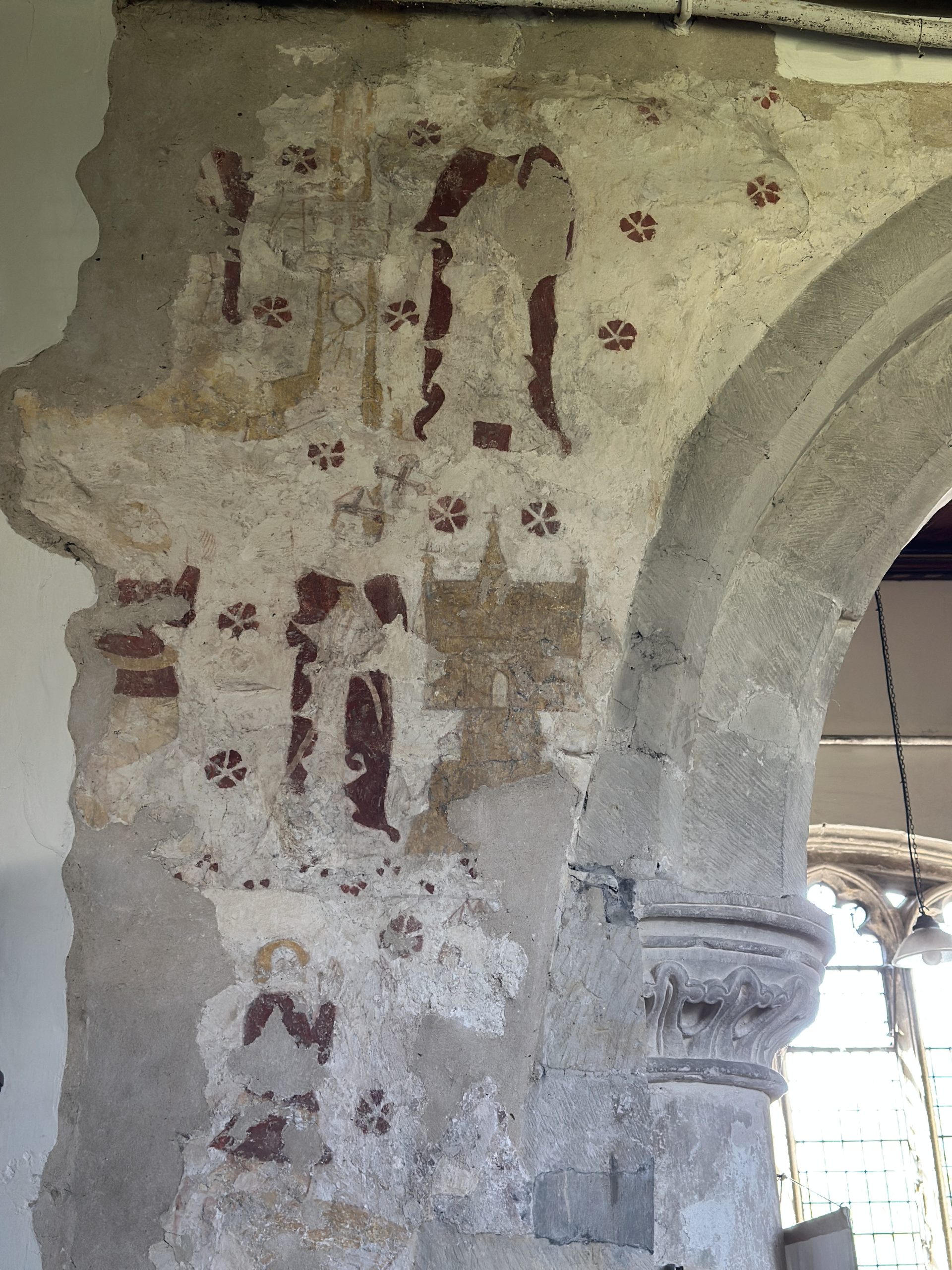
At the eastern end of the north aisle, patches of red and ochre emerge from the plaster. Figures can still be distinguished, small red rosettes are scattered across the background and, amongst the surviving fragments, there is the representation of a church. Without some knowledge of what was once there, it would be very easy to walk past without appreciating its significance. The painting appears to take us back to the earliest recorded years of St Andrew’s and, remarkably, to a medieval rector whom we can name.
A medieval picture on the wall
The wall painting is believed to date from the thirteenth century and has been interpreted as representing the foundation of the church and the institution of its first priest. An explanatory drawing displayed nearby records that the painting was restored in the autumn of 1982 and reconstructs three scenes, or registers, arranged one above another. They include a donor presenting a charter and a bishop blessing or instituting a priest beside a representation of a church.
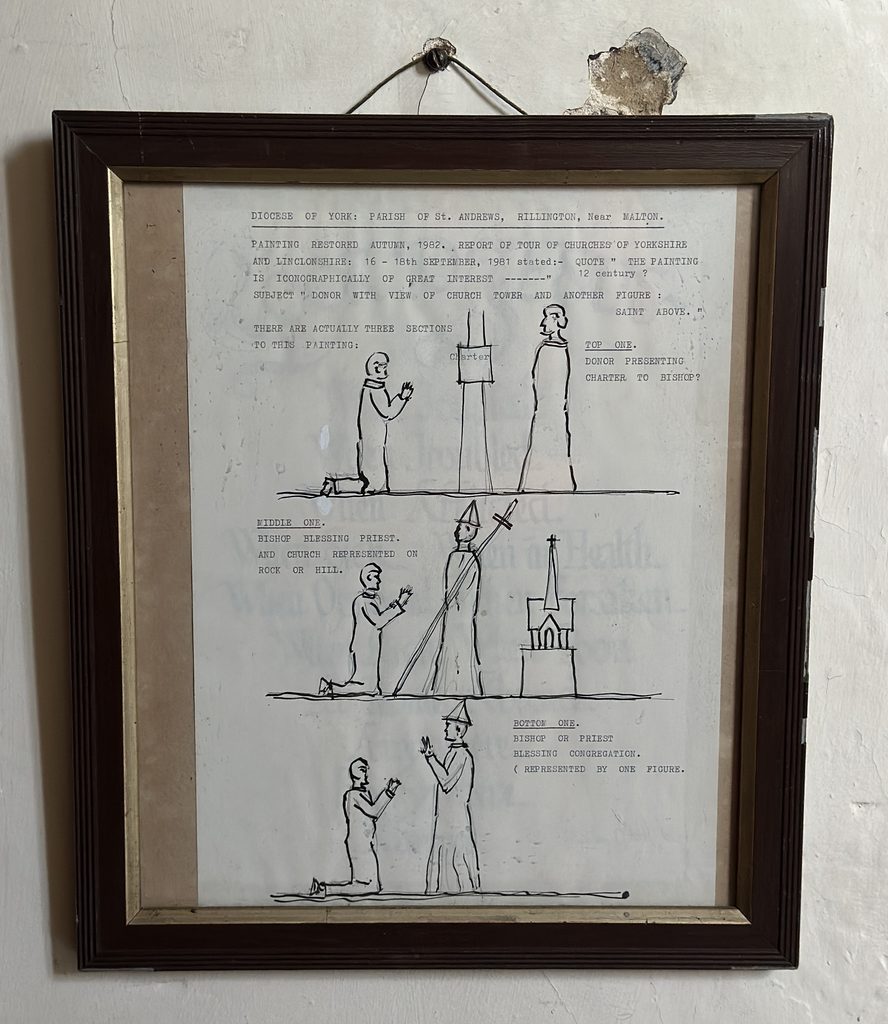
The Rev. William Stratford was already fascinated by the painting when he wrote his Historical Notes of Rillington & Scampston. He similarly described three separate scenes and believed that they related to the building of St Andrew’s and its early clergy. Stratford suggested that the donor represented in the painting might have been William de Cayton, whom he identified as the man who gave the church of St Andrew and land for its maintenance to Byland Abbey in 1230.
It is an enticing interpretation, although one that should be treated as a possibility rather than a certainty. What can be said is that the painting provides a rare visual connection with the medieval church and with the people associated with it. One of those people was Robert de Okham.
The first Rector of Rillington
According to Stratford, Robert de Okham was instituted as the first Rector of Rillington on 3 February 1230 and was presented to the living by the Abbot and Monastery of Byland. At that time monasteries were important patrons of parish livings, and the connection with Byland places medieval Rillington within a much wider ecclesiastical network.
Robert’s name can still be seen inside St Andrew’s. A framed list of the Rectors and Vicars of the parish begins with him in 1230 and continues through almost eight centuries of clergy. There is something rather extraordinary about seeing his name there. Most inhabitants of thirteenth-century Rillington have disappeared almost completely from the historical record, yet Robert remains not only as a name but as a man who may also be represented, however indistinctly, in paint on the church wall.
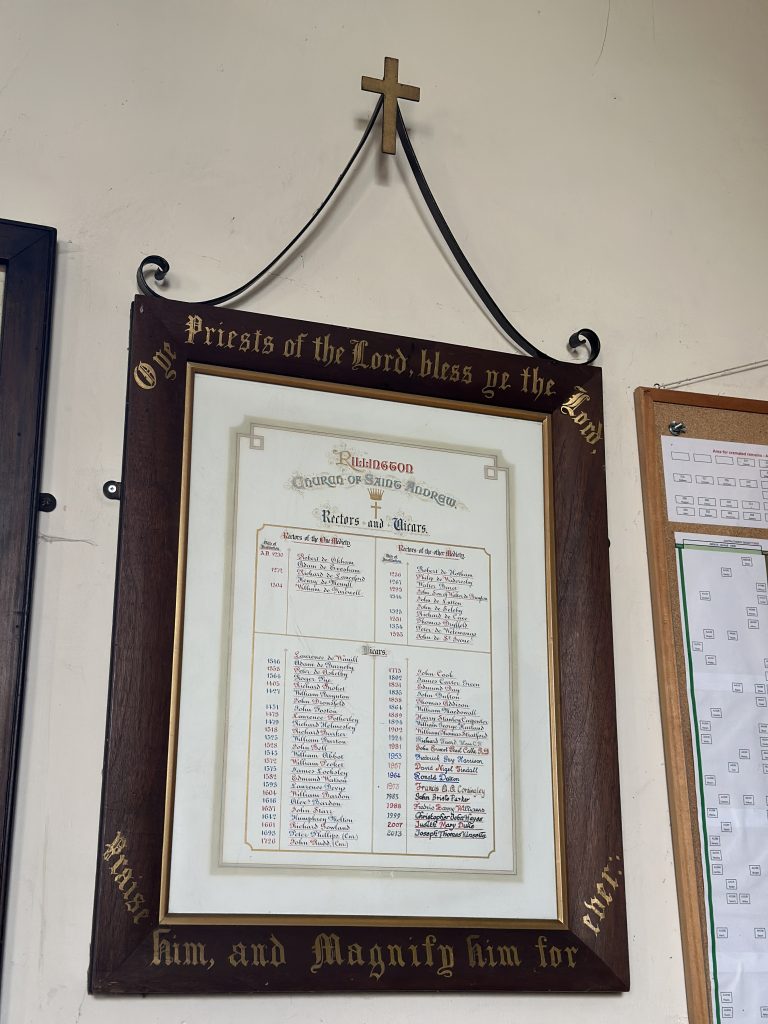
Robert eventually relinquished the living. Stratford observed that the list of rectors does not say that the benefice became vacant through his death and concluded that he probably resigned, perhaps because of ill health or for some other unknown reason. Other priests followed him before Henry de Menyll became one of the rectors of Rillington later in the thirteenth century.
It is at this point that the story takes a rather unexpected turn.
When one priest “laid violent hands” on another
In discussing Henry de Menyll, Stratford referred to what he described as an “ancient record” concerning men and money connected with the Crusades in Yorkshire. At about 1275 Henry de Menyll “took the Cross”. Stratford was quick to point out, however, that Henry may not have done so entirely willingly.
His reason was startling. According to the record as reported by Stratford, Henry’s offence was that “he laid violent hands on Robert, the former priest of Rillington.” Stratford identified the unfortunate Robert as Robert de Okham, the first rector.
Unfortunately for the curious local historian, this is almost all we are told. Stratford could find no account of the quarrel itself and could only speculate about Robert’s circumstances. As Robert had been succeeded by other priests before Henry de Menyll’s appointment, Stratford wondered whether the former rector had remained in the parish after relinquishing the living. If so, the incident may have involved two men with long-standing connections to the same church and community.
The phrase “laid violent hands” also requires a little caution. It was an ecclesiastical expression for physical violence against a cleric and therefore described an offence regarded particularly seriously under medieval canon law. We do not know whether Henry struck Robert once in anger or whether something more substantial occurred, nor do we know what provoked the confrontation. Tempting though it is to picture two medieval Rillington priests settling their differences in a manner rather less dignified than their calling required, the surviving evidence does not allow us to referee the bout.
Rillington and the Crusades
The reference to Henry “taking the Cross” connects this small incident in Rillington with events taking place far beyond the parish. The Crusades are usually encountered through accounts of popes, kings, knights and armies travelling towards the eastern Mediterranean, yet their influence extended much further into medieval society. Preaching, fundraising, vows and ecclesiastical penalties associated with crusading could reach communities far removed from the Holy Land.
Stratford believed that Henry’s taking of the Cross was imposed as a punishment for his violence towards Robert rather than being prompted by crusading enthusiasm. That interpretation needs to remain provisional until the “ancient record” he consulted can be identified and examined for ourselves. Nor can we assume that Henry actually travelled to the Holy Land merely because he had taken the Cross.
Nevertheless, the episode is a reminder that medieval Rillington was not an isolated agricultural settlement existing independently of the wider world. Its parish church was connected with Byland Abbey, its clergy operated within the structures and discipline of the medieval Church, and the consequences of a quarrel between two local priests could apparently become entangled with one of the great religious movements of the Middle Ages.
Scattered fragments
Nearly eight centuries separate us from Robert de Okham and Henry de Menyll, and it is unlikely that we shall ever know precisely what passed between them. The evidence survives only in scattered fragments: a medieval painting on the wall of St Andrew’s, Robert’s name at the beginning of the list of clergy, Stratford’s account of an ancient record and one tantalising statement that a later rector had “laid violent hands” upon his predecessor.
Taken separately, each tells us relatively little. Put together, they allow two men from thirteenth-century Rillington to emerge briefly from the medieval shadows and remind us that the people who inhabited the village eight hundred years ago were not so very different from those who came after them.
There is, however, one final detail inside St Andrew’s which seems particularly appropriate.
Above the door through which generations of parishioners have left the church to return to the village is an old inscription:
“Go and ſin no more.”
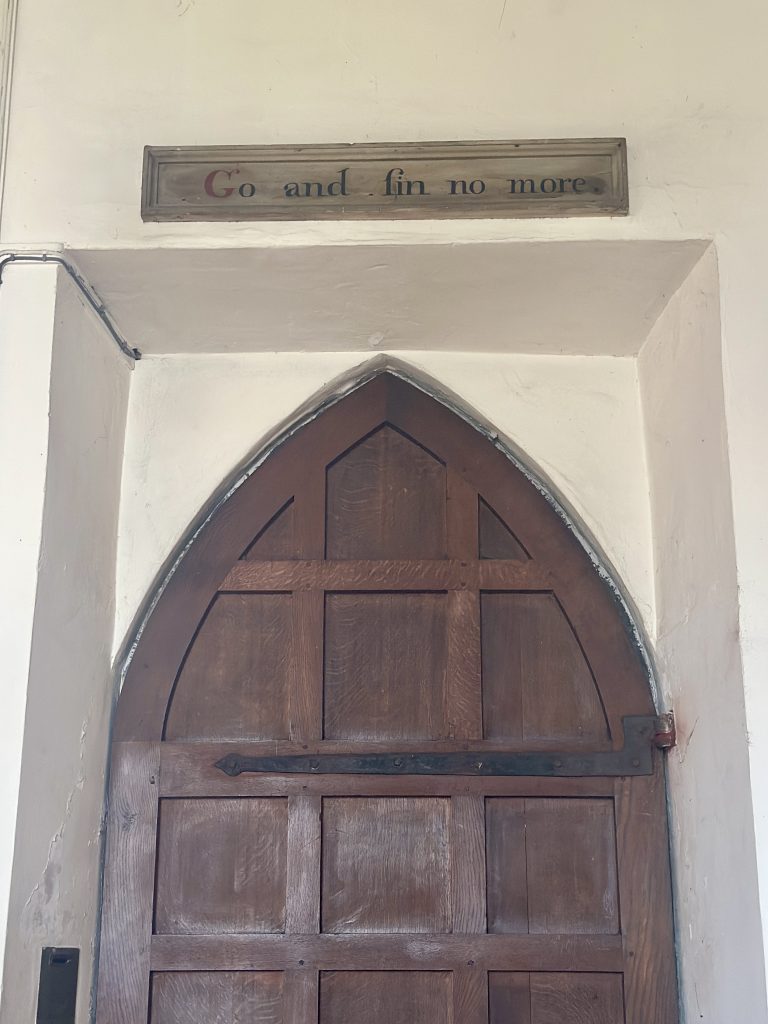
The unfamiliar character is the long s, once commonly used in English writing and printing.
Whether Henry de Menyll ever received that particular piece of advice after laying violent hands upon his predecessor, we shall never know. One rather hopes he did.