
Did the Civil War Pass Rillington By?
At first glance, the English Civil War seems to have passed Rillington by. There was no battle here, no siege and, as far as we know, no famous commander rode dramatically through the village at the head of an army. Look more closely, however, and the picture begins to change.
The war between King Charles I and Parliament began in 1642, but the people of Rillington did not suddenly stop farming their land, having children, marrying, dying, arguing over property or worrying about the harvest. Their names survive in parish registers and other records, allowing us to glimpse a small Yorkshire community living through one of the most turbulent periods in English history. And, even before war broke out, Rillington was changing.
A village already changing
At almost exactly the same time that England was moving towards Civil War, Rillington’s landscape was undergoing changes of its own. Philip Wheath, who had bought one of the village’s two manors in 1613, persuaded the freeholders to enclose the Low Moor, Carrs and other land in 1641. Hudleston’s later history of Rillington records that by 1661 “maister Etherington and maister Wheath” were regarded as the two leading men in the town. The upheavals of the Civil War therefore unfolded against a background of local change already under way.
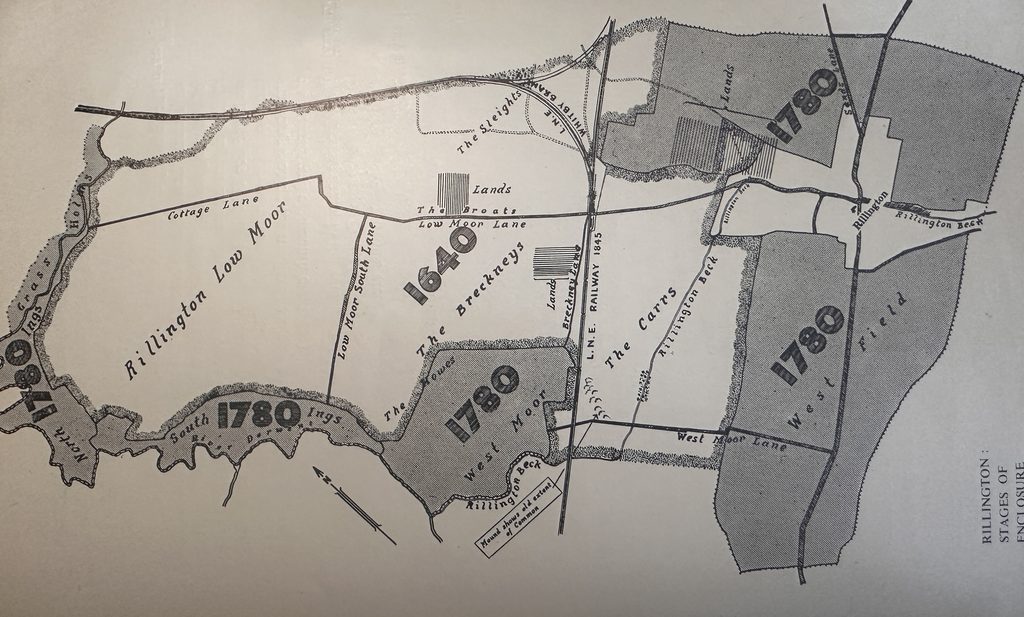
The surviving account describes lengthy meetings and debates before his neighbours were persuaded. The old common-field system was thought to be failing: too many animals were grazing the common land and cultivation was suffering. For the people living here, this was no abstract agricultural reform. Enclosure altered the landscape around them and affected how land that had been used communally for generations could be farmed.
So, on the eve of Civil War, Rillington already had plenty to argue about.
Who was living here?
This is where the parish register becomes invaluable. Open its pages and seventeenth-century Rillington begins to populate itself.
In 1641 we encounter Dorothy Foster, Thomas and Jane Smith, Joseph Wheath, Elin Simpkin, Margaret Fisher, Robert Ruston and Mathew Lambe, among others. The names continue through the war years: Petch, Hodgson, Parkin, Gowland, Preston, Harrison, Collinson, Etherington and many more. These were ordinary people living through extraordinary times.
The register also allows us to glimpse some of the relationships between them. In 1643, for example, Mathew, son of Robert Lambe, appears; in 1644 there is Ann Ruston; in 1647 Thomas Gowland; and in 1650 Ann, daughter of John Collinson. Alongside them were families with considerable property and influence. The Wheaths were one. The Etheringtons were another.
The Etherington family had come to the area from Levisham and had substantial interests in Rillington during the seventeenth century. Members of the family appear in the parish records, while other surviving documents connect them with the Rectory, its land and tithes.
In 1647, during the Civil War itself, a bond for the substantial sum of £300 was made between Stephen Russell of Whitby and Richard Etherington of Rillington. Three years later, an R. Etherington was recorded as holding the Rectory and tithes. Later evidence shows the family’s continuing association with the Rectory and the advowson, the valuable right to present a clergyman to the parish living.
We should be careful not to assume that every seventeenth-century Richard Etherington found in the records was the same man. Nevertheless, the evidence leaves little doubt that the Etheringtons belonged among Rillington’s more substantial families.
By 1658, Lewis Etherington, eldest son of Richard, was admitted to Queens’ College, Cambridge and described as “of Rillington, Yorks., Esq.”
And then comes 1642
Something rather striking happens in the parish register. There are entries in 1641. For 1642 there are none. Then they begin again in 1643.
It would be wonderfully convenient to announce that the outbreak of the Civil War caused the blank year. Unfortunately, history seldom behaves quite so obligingly. Parish registers could become irregular for many reasons, and absence from the register does not mean that no children were born or people died. Nevertheless, the timing is intriguing.
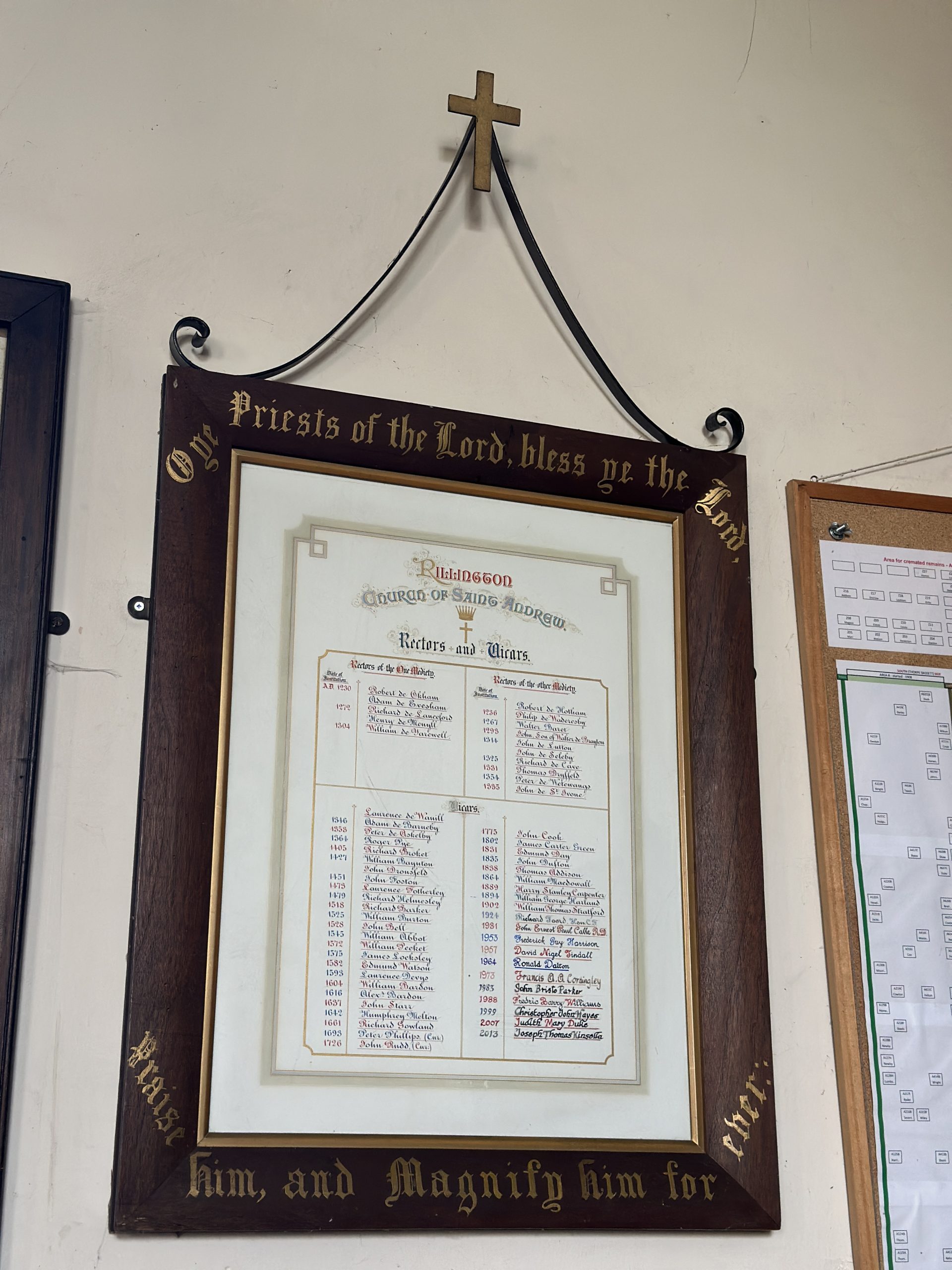
On 27 July 1642 Humphrey Melton was instituted as perpetual vicar of Rillington. The patron was the Crown, Charles I himself, and the timing could hardly have been more striking. Less than a month later, on 22 August, the King raised his standard at Nottingham, conventionally marking the beginning of open Civil War in England.
What happened to Melton’s position at Rillington during the years that followed is less clear. By 1661 Richard Gowland appears as vicar. The surviving evidence gives us the two ends of the story, but not everything that happened between them.
How close did the war come?
Rillington may not have been a battlefield, but it was certainly not isolated from the conflict around it. The main route between York and Scarborough passed through this part of Yorkshire, while Malton and the crossings of the rivers Derwent and Rye were strategically important to forces attempting to control movement through the district.
The wider East Riding saw considerable military activity. York remained firmly in Royalist hands while much of the East Riding came under Parliamentarian control, and the balance shifted as the war progressed. In early 1643, the Parliamentarian commander Sir Hugh Cholmley was concerned with protecting the road between York and Scarborough, while nearby Yedingham Bridge became part of the struggle over strategically important river crossings.
By early 1644 the fighting had moved even closer. Parliamentarian forces under Sir William Constable raided into the Wolds, camping at Cowlam and taking prisoners there in February. Bridlington was subsequently captured, with further skirmishing involving Royalist forces at Driffield and Helperthorpe. Rillington therefore lay within a landscape in which troops were moving, garrisons were changing hands and military action was taking place only a matter of miles away.
Then, on 2 July 1644, came one of the decisive battles of the Civil War. Royalist and Parliamentarian forces met at Marston Moor, west of York, where the Royalists were defeated. William Cavendish, Marquis of Newcastle, subsequently left York and made his way to Scarborough before escaping by sea to the Continent.
It is tempting to imagine Newcastle and his escort passing through Rillington on their way to the coast, but we simply do not know that they did. His precise route between York and Scarborough has not been established, and I am certainly not putting a seventeenth-century Royalist commander through Rillington simply because it makes a good story.
What we can say with confidence is that military forces were operating along the York-Scarborough corridor and across the Wolds, while strategic crossings and settlements close to Rillington were caught up in the conflict. The Civil War did not have to reach Rillington to be uncomfortably close.
Meanwhile, life went on
Perhaps the most affecting thing about the parish register is its ordinariness. Children continued to arrive. In 1643 there were baptisms for children from the Watson, Ledget, Coop, Challener, Lambe, Smith and Wilson families. In 1644 came Coolbye, Petch, Postell, Ruston, Chapman and Hodgson. The following years bring Parkin, Hyde, Lambe, Gowland, Banks, Harrison and others.
The number of surviving entries fluctuates considerably. There are only three in 1645, more in 1648, and just three again in 1651.
We cannot turn those figures into a population graph. A quiet register is not necessarily a quiet village. What it shows is what was recorded, not everything that happened.
Yet through all the political and military upheaval, the same family names keep appearing. For most inhabitants, ordinary village life continued alongside extraordinary national events.
What happened at St Andrew’s?
Here the story becomes particularly interesting.
Humphrey Melton had been instituted as vicar in 1642, but by 1652 the parish register contains another intriguing description:
“Mary d John Lambe minister.” Who was John Lambe?
The surname was already established in Rillington, but searches of the surviving clerical records have not identified this particular John Lambe. Nor can we assume that the word minister meant that he was the incumbent vicar.
His appearance nevertheless falls right in the middle of a period when the Church of England had been profoundly disrupted.
Charles I had been executed in January 1649. The monarchy and House of Lords were abolished and England became a Commonwealth. Bishops had already been removed from the Church, and the familiar structures of parish religious life were changing.
Who John Lambe was, and what position he held in Rillington in 1652, remains unanswered.
When baptisms became births
Then the parish register itself begins to change. Earlier entries record baptisms. During the 1650s the heading changes to births.
This was not simply a Rillington peculiarity. In 1653 the Commonwealth introduced a new system of civil registration. Each parish was to appoint a registrar to record births, marriages and deaths rather than baptisms, marriages and burials. Marriage also became a civil ceremony rather than solely a church sacrament, with Justices of the Peace playing an important role.
Suddenly, national political and religious change is visible on the pages of Rillington’s own register. And one marriage illustrates it beautifully.
Robert and Elizabeth get married Commonwealth style
In 1654 Robert Hodgson and Elizabeth Foster of Rillington wished to marry. Under the new arrangements, their intention to marry had to be publicly announced. The Rillington record notes publication of their intention on successive occasions before their consent was given in the presence of Christopher Pearcey of Ryton, Esquire, one of the Justices of the Peace for the County of York.
This looks very different from the earlier, brief parish marriage entries. For a modern reader, all the constitutional arguments of the Commonwealth can seem remote. But here they are translated into the lives of two people in Rillington. Robert and Elizabeth wanted to get married. And because England’s government and religious settlement had changed, the way they did it had changed too.
Then the King came back
The year 1660 is particularly striking. Three deaths and one marriage were recorded, but there are no apparent entries for births or baptisms, and no surviving Bishops’ Transcript. From 1661, the Bishops’ Transcript entries are once again described as baptisms.
That distinction matters. The parish register had not simply ceased to function in 1660; some events were still being recorded. It is specifically the record of births or baptisms that is absent. The following year, as the Church of England was being re-established after the Restoration of Charles II, baptisms reappear in the record.
In 1661 Richard Gowland became vicar of Rillington. He had been ordained as both deacon and priest in 1643, so he was himself a clergyman whose career had spanned the upheavals of Civil War and Commonwealth. In August 1662 he subscribed to the Act of Uniformity, accepting the restored forms and worship of the Church of England.
And then comes one of my favourite entries in the whole story. On 17 February 1662, the parish register records:
Ralph Hardy & Rosamond Abbot were married according to the Cannon [canon].
The spelling is that of the original record. Cannon meant canon: the law and established practice of the Church. Only a few years earlier, marriages in Rillington were being recorded under the Commonwealth’s civil arrangements. Now Ralph and Rosamond were married “according to the Cannon.” In six words, the Restoration had arrived in Rillington.
So, did the Civil War pass Rillington by?
I began by wondering whether it had but I don’t think it did.
There is no evidence of a battle in Rillington and I have not found proof of soldiers fighting in its streets. We cannot yet place the Marquis of Newcastle on the road through the village, however tempting that might be. What survives is something more subtle.
The evidence lies in a changing landscape, familiar village names, the arrival and disappearance of clergymen, and, perhaps most revealingly, the parish register itself. Baptisms become births; marriage passes into civil authority; then, after the Restoration, Anglican practice returns and Ralph Hardy and Rosamond Abbot are married “according to the Cannon”.
No muskets have been unearthed. No cannonballs have rolled out of a Rillington garden. There is no plaque telling us that Charles I slept here. We have something quieter.
The Civil War survives in Rillington in land, names, clergy and the changing words written into an old parish register. And perhaps that is exactly how a national upheaval should look when viewed from one small Yorkshire village.