
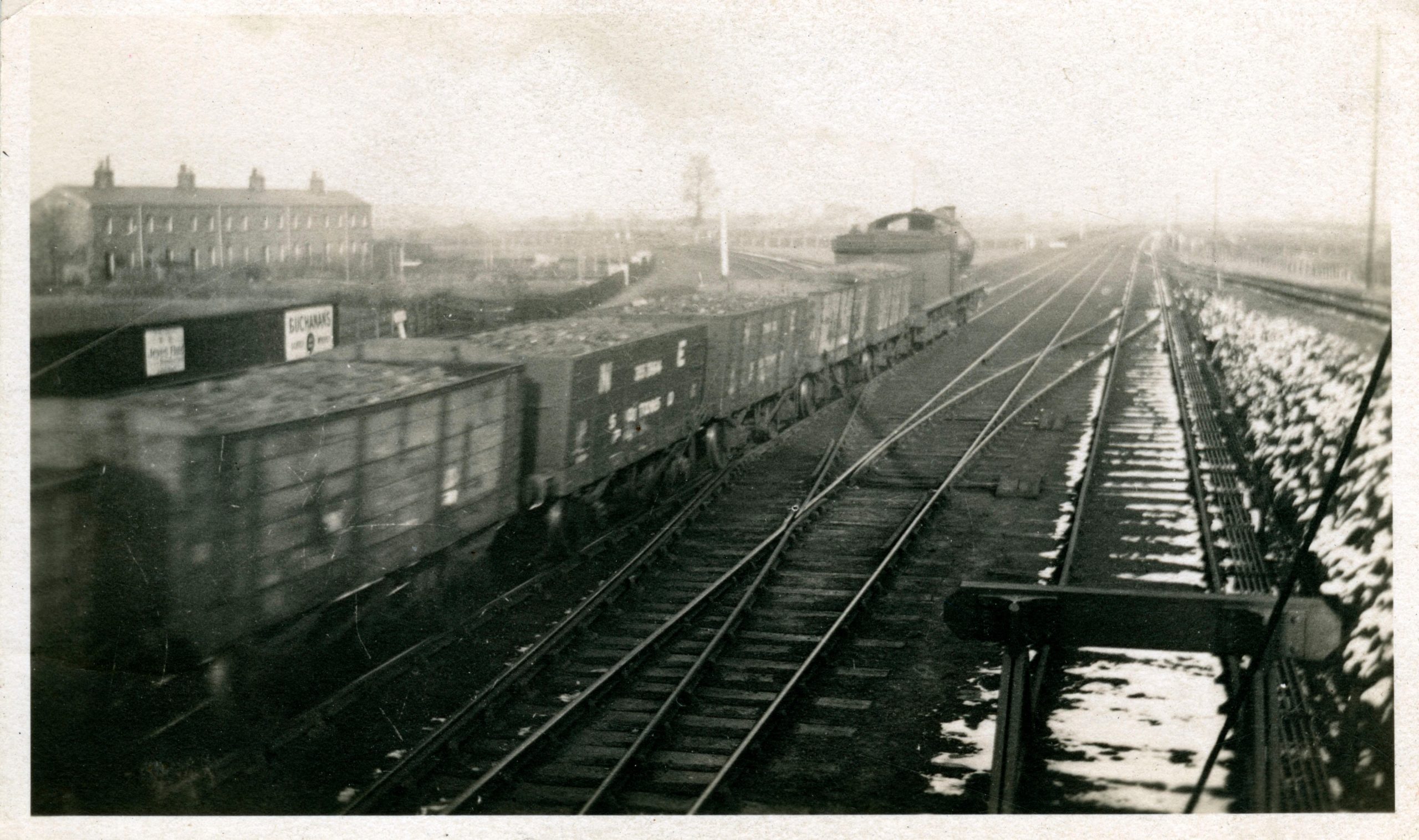
The New Neighbours: Who Came with the Railway?
On 7 July 1845, the York and North Midland Railway opened its new line between York and Scarborough. For Rillington, the railway brought far more than trains passing through the parish. It brought a new industry, new occupations and new neighbours.
Six years later, on the night of the 1851 census, the enumerator recorded something that had not existed in Rillington a decade earlier: a small community living and working around the railway station, its cottages and coal yard.
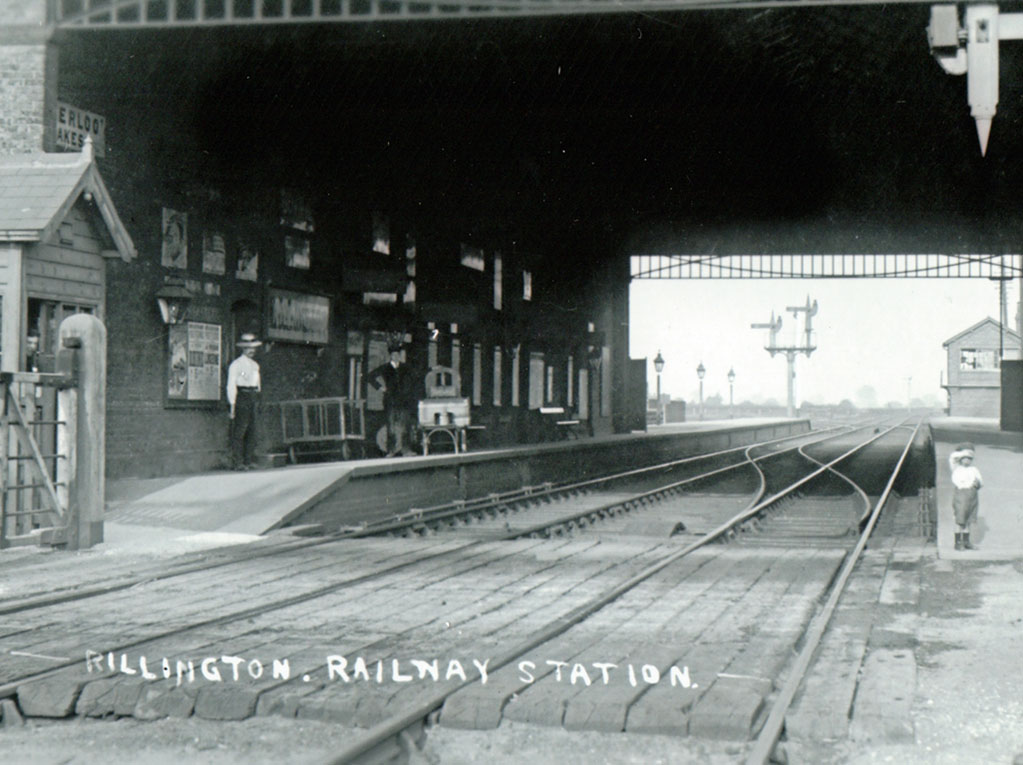
Who were these people? Where had they come from? And what had they been doing before the railway brought them to Rillington? The answers reveal that there was no such thing as a typical early railwayman.
From chemist and coach proprietor to stationmaster
One of the first residents recorded at Rillington Station was James Booth, living there with his family in 1851.
James was already 68 and had spent much of his earlier life in Doncaster. The baptism records of his children reveal that during the 1820s and early 1830s he worked as a druggist and chemist. Then, by 1834, his occupation had changed completely: he was a coach proprietor.
It did not end well. His business failed and in 1836 James was declared bankrupt. He subsequently returned to pharmaceutical work before making another remarkable change of direction and joining the railway. In 1851 he was described as a railway clerk at Rillington; when his wife Frances died at Rillington Station in 1855, James was recorded as a railway stationmaster.
There is something rather fitting about a former coach proprietor finding a new career on the railway. James had worked in an industry that helped people travel before the railway arrived, then found employment in the new technology that was rapidly transforming long-distance transport.
The Booth family’s connection with Rillington was relatively brief. Frances and their daughter Fanny both died while living at Rillington Station and were buried at St Andrew’s. James later moved to Pickering, where he died in 1859.
A new career for a labourer
Living in the newly constructed railway cottages was Francis Harrison, his wife Jane and their five children.
The birthplaces and baptisms of those children provide a trail through Yorkshire to Kirby Wiske, Leeds, York and eventually Rillington but they also record Francis’ changing occupation.
When daughter Mary Ann was baptised in 1837, Francis was a labourer. He was still described as a labourer when Isabella was baptised in Leeds in 1841. By the time Margaret was baptised in York in 1846, however, he had become a plate layer, maintaining the railway track.
When son John was baptised at Rillington in 1849, Francis had risen to railway inspector. The railway had not simply given him a different job. It had provided a route from general labouring into increasingly specialised railway employment.
By 1861 the family had moved again, this time to the Railway Gate House at Norton, where Francis was working as a gatekeeper. Rillington had been one stage in a working life that increasingly followed the railway.
One of Rillington’s own
Not everyone came from elsewhere. Thomas Preston Dixon was born in Rillington, the son of Robert Dixon, a miller. The railway changed the employment opportunities available to this local family too. Robert later worked as a railway porter and was living at Rillington Station when he died in 1849.
In 1851 his unmarried son Thomas, aged 23, was living next door to the Harrisons with his widowed mother Rebecca. Thomas was employed as a railway labourer. Ten years later he had moved to the railway cottages at Pickering and become a plate layer.
Thomas remained in railway employment for the rest of his working life. By 1901, more than half a century after we first find him amongst Rillington’s railway community, he was a railway points gatekeeper at Westgate Carr, Pickering.
For the Dixons, therefore, the railway did something slightly different. It did not bring a new family into Rillington; it drew an established Rillington family into an entirely new industry.
From horses to railways
Perhaps one of the clearest examples of the changing world is William Gibson. William had been baptised at Rillington in 1816, but by 1841 he and his wife Maria were living in York. His occupation was that of an ostler; someone employed to look after horses, particularly those belonging to travellers staying at an inn. Then came the railway.
The baptisms of William and Maria’s children record both the family’s movements and William’s changing work. In York he was still an ostler. By the time a son was born at Welburn he was a labourer. At the Marishes in 1848 he was described as a railway labourer, and after the family reached Rillington he was recorded as a railway repairer.
By 1861 the Gibsons had moved on to Kirby Station near Pickering and William had become a plate layer. Later still he worked as a railway gateman.
The transition is striking. A man who had once earned his living caring for the horses of travellers spent the rest of his working life serving the industry that was changing how those travellers moved around the country.
The railway porter who disappeared
Another household in the railway cottages belonged to William Brown, a railway porter, his wife Martha and their young sons Harewood and William.
The family appears to have settled in Rillington quite early in the railway’s life. Harewood was baptised here in 1847, William in 1849 and daughter Elizabeth in 1851. On each occasion their father’s occupation was recorded as porter.
Then the trail becomes much less certain. Martha died at Rillington Station in 1854, aged only 33, and was buried at Lastingham. After that, despite extensive searching, I have been unable to identify William and the children with confidence in subsequent census or civil-registration records.
Sometimes that is where family history has to stop. Not everybody leaves a neat trail through the records.
Living among the railway families
There was another interesting resident of the railway cottages who wasn’t actually a railway employee.
Charles Stubbs lived with his wife Harriet, their children and members of Harriet’s family between the Gibson and Brown households. In 1841 Charles had been a grocer at Norton. By 1851 he was described as a bonesetter.
Bonesetters were not formally employed by the York and North Midland Railway, so Charles cannot properly be counted amongst Rillington’s railway workforce. But his presence amongst families engaged in physically demanding and potentially dangerous railway work is intriguing. He was quite literally living amongst his potential customers.
Down at the coal yard
At the Rillington Station coal yard lived another young family: Robert and Mary Medd.
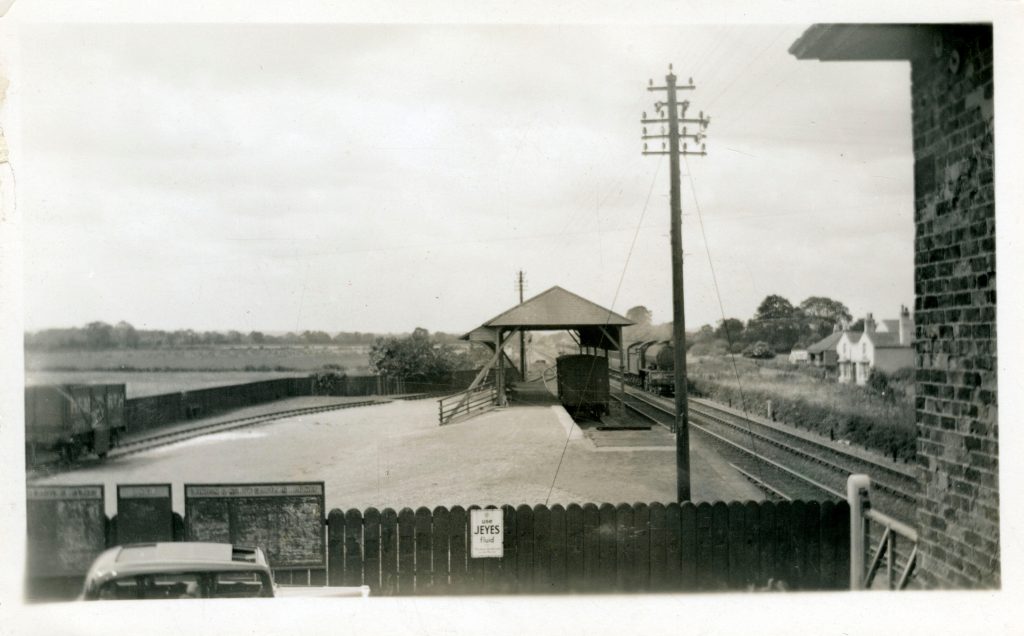
Robert’s working life had already taken several turns. When daughter Ellen was baptised in 1844 he was a schoolmaster. By 1846 he was a labourer and, after arriving in Rillington, a coal porter.
This time, however, the railway became much more than a temporary job. By 1861 the Medds had moved to the North Street Coal Depot at Wetherby, where Robert was a coal agent. Later records show the family living at the Railway Station House and Station Lodge there, with Robert remaining in railway coal employment until retirement.
And the connection continued into the next generation. Robert’s daughter Mary Hannah married Thomas Knaggs, who became an assistant stationmaster and later a railway inspector with the North Eastern Railway. By 1921 another member of the extended household, a son-in-law, was working as an NER signalman. The Medds had become a railway family.
Where did they come from?
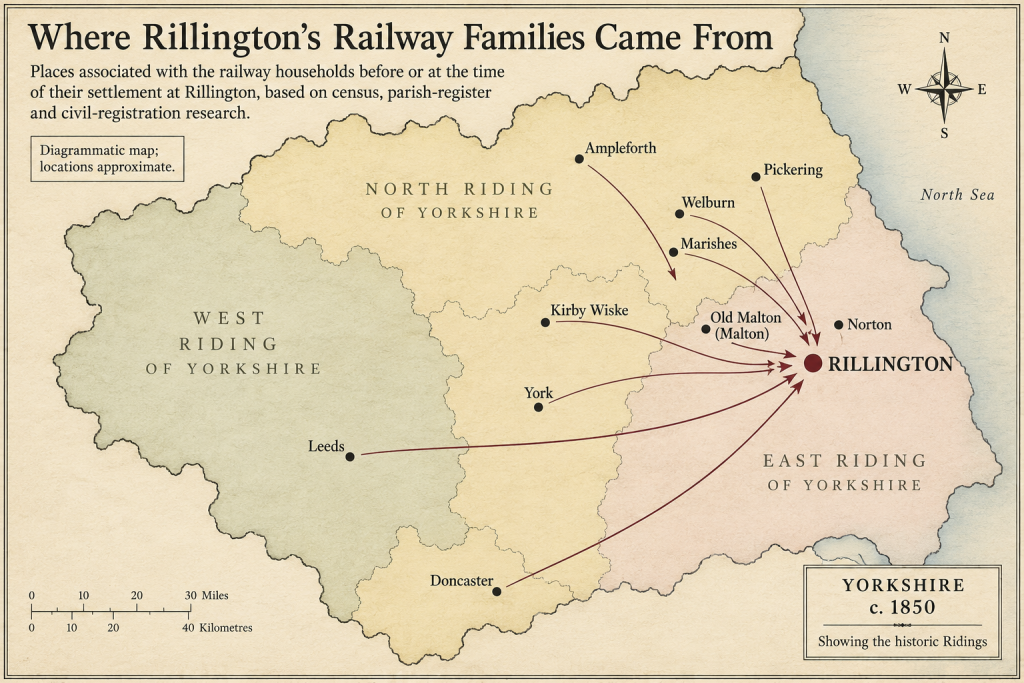
Taken individually, these families are interesting pieces of genealogy. Put them together and something much more important emerges.
Some were Rillington people who found new work on their doorstep. Others arrived from elsewhere. Their previous occupations included chemist, coach proprietor, labourer, miller, ostler and schoolmaster.
Within only a few years a completely new vocabulary of employment appears in the records: railway clerk, stationmaster, porter, plate layer, inspector, repairer, gatekeeper and coal porter.
And Rillington was not necessarily their final destination. The Harrisons moved to Norton. The Dixons and Gibsons followed railway employment towards Pickering. The Medds went to Wetherby. The railway that had brought workers into Rillington could just as readily carry them onwards. The 1851 census therefore captures something rather special: a new community at the moment it was taking shape.
More than trains
It is easy, looking back at the coming of the railway, to concentrate upon engineering: tracks, bridges, stations and steam locomotives.
But the railway changed people too. It offered some established villagers a new occupation. It brought unfamiliar families into the parish. It provided houses as well as work. It allowed labourers to acquire specialist skills and, in families such as the Medds, railway employment became something that could continue through succeeding generations. Census evidence shows repeated relocation along the railway network and the development of a mobile community whose working lives became tied to the line.
For a few years in the middle of the nineteenth century, James Booth, Francis Harrison, Thomas Dixon, William Gibson, William Brown, Robert Medd and their families were neighbours. They were Rillington’s new railway community.
And fortunately for us, the census enumerator called while they were all at home!