
Methodists in Deeds
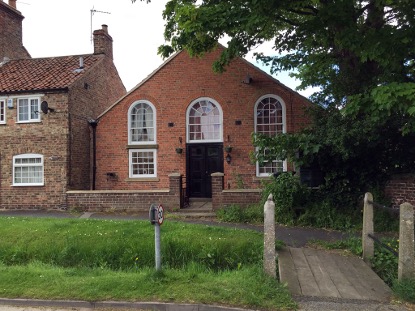
On Low Moorgate in Rillington stands a red-brick building with three tall, round-headed windows. Today it is a private home, but for generations it was the Wesleyan Methodist Chapel.
Its history survives not only in the building but in an extraordinary collection of original deeds. Some are enormous sheets of parchment, densely covered in legal handwriting and finished with signatures and red wax seals. Together, they preserve something rather more interesting than a succession of property transactions. They preserve the names of the people who built, supported and took responsibility for the chapel over generations.
It begins in 1803
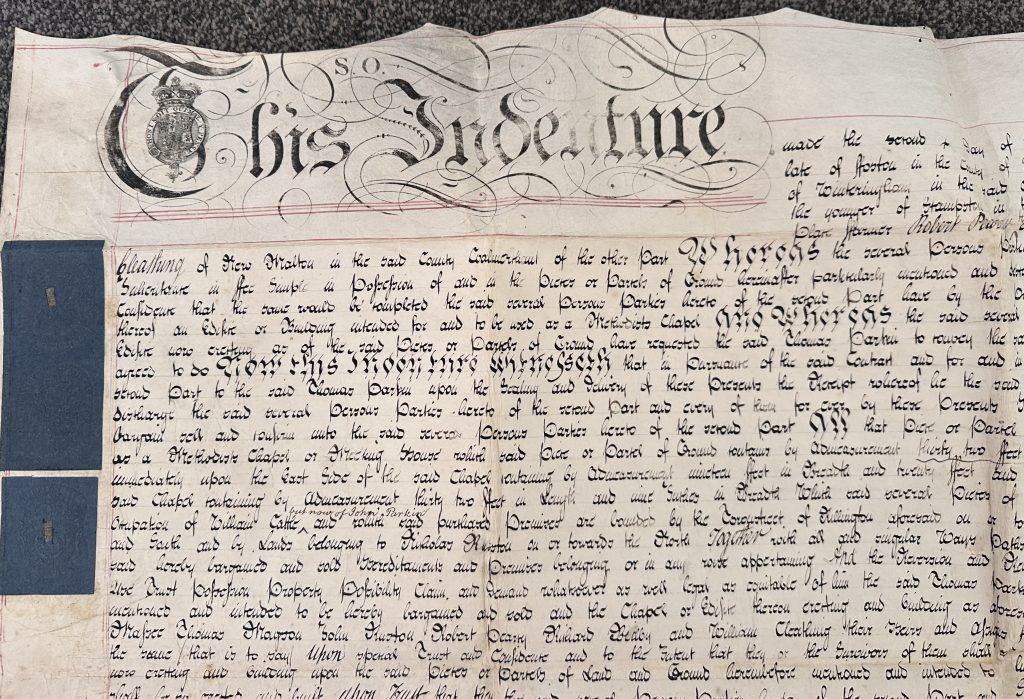
The earliest surviving deed is dated 2 November 1803. Thomas Parkin, formerly of Foston, land surveyor, but by then a gentleman living at Beverley, agreed to sell land in Rillington for £10 to nine men:
John Hodgson, miller, of Wintringham
William Creaser, farmer, of Wintringham
James Kirby, tailor, of Wintringham
William Massee the younger, farmer, of Scampston
Thomas Magson, labourer, of Rillington
John Rushton, farmer, of Rillington
Robert Pearcy the younger, schoolmaster, of Rillington
Richard Bielby, labourer, of Scagglethorpe
William Cleathing, coal merchant, of New Malton.
The men responsible for establishing the chapel were therefore not drawn solely from Rillington. They came from Wintringham, Scampston, Scagglethorpe and New Malton as well as the village itself. Nor were they all men of the same social standing: amongst them were farmers, labourers, a miller, tailor, schoolmaster and coal merchant.
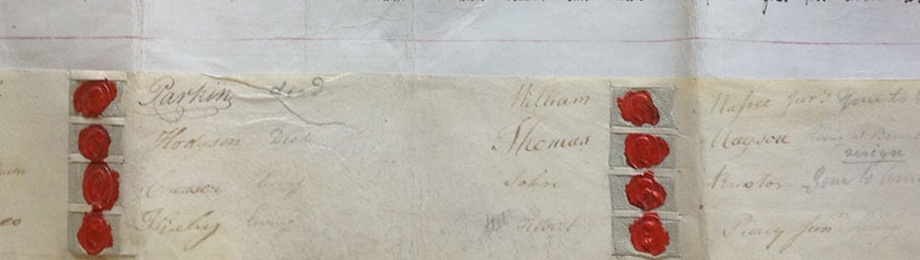
Figure 2. Signatures and red wax seals from the 1803 deed, with later annotations recording what became of some of Rillington’s original Methodist trustees.
There was also an organisational reason for this geographical spread. Methodist chapels did not operate as isolated parish congregations but as part of a wider circuit, through which itinerant ministers travelled between communities. The Minutes of the Methodist Conference confirm that in 1803, the very year of the first Rillington deed, the chapel belonged to the Scarborough Circuit. The chapel may have stood in Rillington, but from its beginning its Methodist life extended well beyond the parish boundary.
And the deed tells us something even more important. Before the conveyance had been completed, the purchasers had, with Parkin’s permission, “began to erect and build” on the land an edifice intended to be used as a Methodist chapel.
The documentary history of the chapel therefore begins not in 1805, the date traditionally associated with it, but in 1803, when the building was already under construction.
The land itself was described in considerable detail. The chapel plot measured approximately 32 feet in length and 29 feet in breadth, with additional pieces of ground to the east and north. It formed part of a garth or croft formerly occupied by William Cattle and subsequently by John Parkin.
Even the chapel windows were protected. Thomas Parkin retained adjoining land on the west and south, but covenanted that nothing should be done there which might cause the chapel’s existing lights or windows to be “obstructed lessened or darkened.” The trustees and their workmen were also allowed access to his adjoining ground to erect scaffolding whenever the chapel needed repairing, painting, altering, enlarging or rebuilding.
Looking at the large round-headed windows which remain such a distinctive feature of the building today, it is an irresistible detail, although we cannot assume that the present windows are those referred to in 1803.
John Wesley and the Rillington deed
The 1803 deed places this small Yorkshire chapel within the much wider Wesleyan movement. It refers specifically to the deed made under the hand and seal of the Rev. John Wesley on 28 February 1784, enrolled in Chancery, which established the legal Conference of the people called Methodists.
Wesley had died in 1791, twelve years before the Rillington deed was executed, but the system he had established governed who could preach in the new chapel. Only those appointed through the Methodist Conference were to preach there, and the Rillington deed stipulated that they should preach no doctrines other than those contained in Wesley’s Notes upon the New Testament and his four volumes of sermons.
This was therefore not simply a local meeting house erected by nine men. Legally, doctrinally and administratively, the new chapel belonged to a much wider Wesleyan world.
The trustees were instructed to finish the building “with all convenient speed” and were given powers to raise money towards its purchase, construction, future repair and administration.
Most importantly for the story which follows, the deed stipulated that there should continue to be nine trustees, all members of the Methodist Society. Whenever one died, declined to act or ceased to be a Methodist, another Methodist was to be appointed in his place, so that the number might be “kept up forever.” That provision created the remarkable paper trail which survives today.
Dead, resigned or gone to America
At some later date, somebody went back to that magnificent 1803 deed and made annotations beside the original names. Some trustees had died. Others were still living. Thomas Magson was living at Beverley and was to resign. William Cleathing was also to resign.And beside two of the original trustees appears something much more unexpected.
William Massee had gone to America. So had John Ruston.
These brief annotations were probably made for the practical purpose of establishing which trustees remained able to act and who needed replacing. More than two centuries later, however, they transform a legal document into a genealogical source. Within a few words we see death, migration and movement away from Rillington. The nine men of 1803 were already becoming part of the chapel’s history.
The village around the chapel
An 1812 manorial rental of the estate of John Simpson M.D. provides another glimpse of the Rillington and Scampston community only nine years after the first chapel deed.
The rental records substantial occupiers alongside people holding what were described simply as “small parcels” of land. Amongst them was Thomas Binks, already familiar from another Rillington story, who paid £3 2s 6d a year for land on the Simpson estate. The rental is useful here not because it tells us directly about the chapel, but because it helps reconstruct the economic and social landscape in which the early Methodists lived.
By 1823, Edward Baines’ directory gives us a much fuller snapshot. Baines described Rillington as a parish in the wapentake of Buckrose, five miles north-east of Malton, with a population of 683. Alongside St Andrew’s parish church he recorded “a chapel for the Independents and another for the Methodists.”
The directory then introduces us to the people living and working around them. There was Thomas Allanson, surgeon, while the Rev. George Sykes was the Independent minister. Robert and Joseph Simpkin were blacksmiths and farriers. Farmers and yeomen included the Adamsons, Banks, Dale, Harper, Harrison, Lambs, Owston, Pickering, Prestons, Rustons, Stephensons and Young.
Elsewhere appear grocers, shoemakers, tailors and wheelwrights, together with John Bielby, gardener; Joseph Cook, butcher; William Croser, flour dealer; James Dixon and Francis Owston, brickmakers; Robert Piercy, schoolteacher; Christopher Postdill, plough maker; John Shaw, shopkeeper; John Simpkin, watchmaker; Matthew Spanton, brewer; and Anthony Stephenson, victualler.
These names matter. They give us the community amongst whom Rillington Methodism developed and many are surnames which recur repeatedly in the records of the village.
Baines’ reference to both Independent and Methodist chapels also reminds us that Wesleyan Methodism was only one strand of Rillington’s unusually varied Nonconformist life.
Methodism in action
The deeds tell us who was responsible for the property. Newspapers occasionally allow us to see what happened when people actually gathered there.
On Monday 3 October 1842, the anniversary of the Wesleyan Methodist Missionary Society for Rillington was celebrated. The Yorkshire Gazette reported that a public meeting was held in the afternoon. Amongst those taking part were the Rev. C. Clay of Scarborough, the Rev. William Coultas of Malton and the Rev. William Ayre of Rillington, together with Mr Swallow of Leeds and other ministers and friends.
Preparatory sermons had been preached on the previous Sabbath, another sermon followed on the Monday evening, and collections were made in aid of the Society’s funds.
The geography is significant. The pattern already visible amongst the trustees of 1803 appears again nearly forty years later. Ministers and speakers moved between communities because Rillington belonged to a Methodist organisation which extended beyond the village. Methodist chapels did not operate as isolated congregations within parish boundaries but formed part of a wider circuit system, served by itinerant ministers and local preachers. The chapel was local. Methodism was connexional.
One generation replaces another
The surviving deeds then allow us to watch the mechanism established in 1803 doing exactly what its creators intended. As trustees died, moved away or ceased to act, others took their places. New deeds and appointments carried the trust forward through the nineteenth and twentieth centuries.
One of the later nineteenth-century deeds is another magnificent parchment document, complete with signatures and red wax seals. Amongst the names appearing in the later chapel records is Enos Piercy, already familiar from another part of Rillington’s history. His appearance here is a useful reminder of how the different threads of a village community overlap. Someone encountered in poor-relief or parish records can reappear in a completely different setting; in this case amongst those associated with the Methodist chapel.
The documentary sequence continues into the twentieth century. The surviving papers refer to deeds dated 24 October 1923 and 30 June 1933. The original 1933 document is not amongst the papers now in the collection, but its existence and date are recorded in later trustee documents. That is evidence enough to establish its place in the chain, while leaving the missing deed honestly missing.
The trustees in the twentieth century
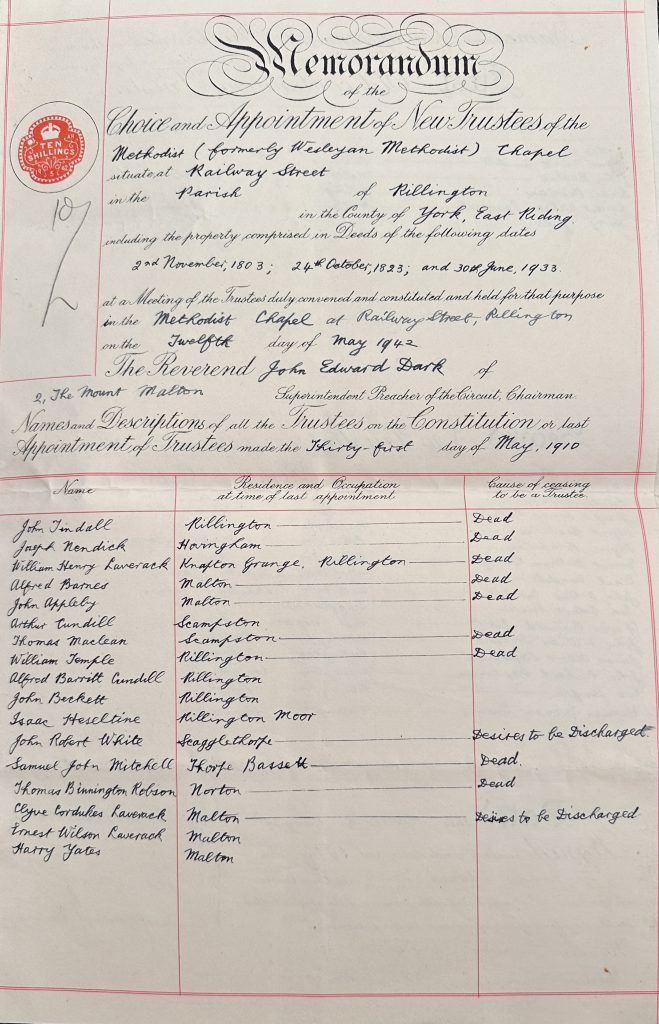
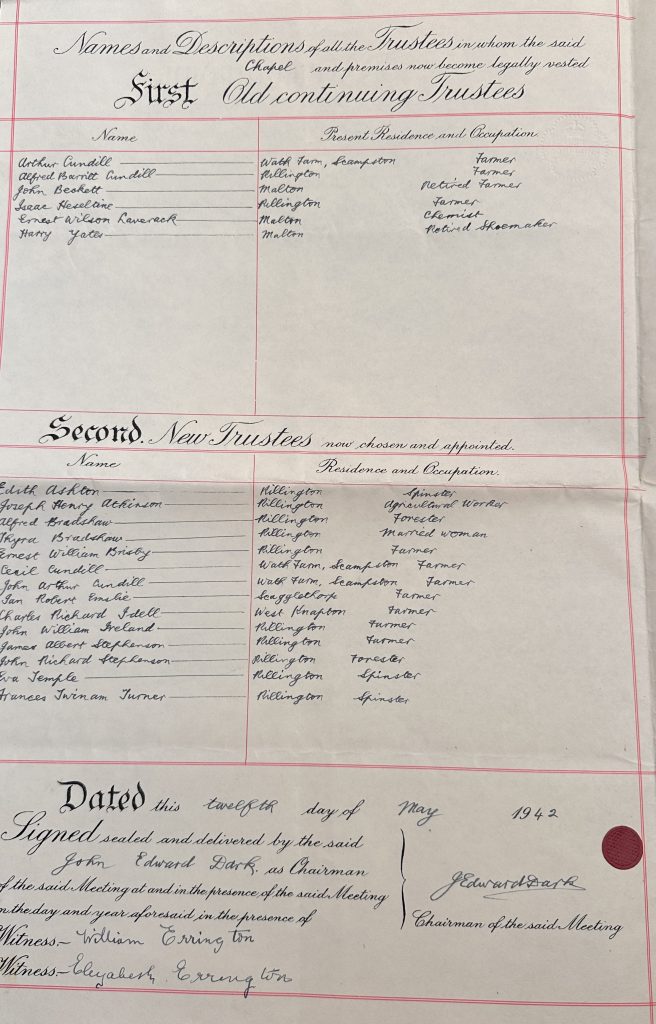
A Memorandum of Choice and Appointment of New Trustees dated 12 May 1942 records both earlier trustees and those chosen to succeed them.
Once again, residences and occupations bring the names to life. Farmers appear alongside a forester, agricultural worker, chemist and retired shoemaker. Women now appear amongst those formally entrusted with the property.
The Cundill family is particularly noticeable. Arthur Cundill of Wath Farm, Scampston, and Alfred Barrett Cundill of Rillington appear amongst the trustees. By 1973, Cecil Cundill of Wath Farm, Scampston, and John Arthur Cundill of Rillington were amongst the continuing trustees. Intriguingly, there is still a Cundill Cottage at Scampston. Whether its name can be connected directly with this family remains to be established, so for the moment it remains a tantalising thread rather than a conclusion. One for another day.
From Wesleyan to Methodist
The twentieth-century documents record changes taking place far beyond Rillington.
Following the Methodist Union of 1932, the previously separate Wesleyan, Primitive and United Methodist Churches became one Methodist Church. Rillington itself had possessed both Wesleyan and Primitive Methodist traditions, so care is needed when following the records of the different chapels.
By 17 March 1960, the trustees of the former Wesleyan chapel had adopted the Methodist Church’s New Model Deed for the property, then described as the Methodist Chapel at Railway Street, Rillington.
A further trustee appointment on 7 March 1973 describes it explicitly as:
“METHODIST [FORMERLY WESLEYAN METHODIST] CHAPEL” at Railway Street.
Five existing trustees continued and six new trustees were appointed. Amongst the continuing trustees were Edith Ashton of Sledgate, Rillington; Cecil Cundill of Wath Farm, Scampston; and John Arthur Cundill of Rillington. The new trustees included members of the Atkinson family of Scampston and Harley Bowes of Sands Lane, Rillington. The occupations had changed and so had the legal machinery, but the principle established in 1803 remained recognisable: responsibility for the chapel passed from one group of people to another.
From Railway Street back to Low Moorgate
Even the address recorded in the documents reflects changes in Rillington. Low Moorgate became associated with the railway following its arrival in the village and was subsequently known as Railway Street. The twentieth-century Methodist documents consistently use the Railway Street address. By the time the former chapel passed into private ownership, the property was once again described as being on Low Moorgate.
The building survives today as a private residence. Its three tall windows still give away something of its former purpose to anyone who knows what they are looking at.
How did the deeds survive?
There is one final part of their story which has nothing to do with Methodist administration.
The deeds were not found in a chapel archive or record office. They had somehow travelled away from Rillington and eventually ended up in the loft of a house in Scarborough.
After his mother died, her son found the bundle while clearing her house. Having discovered the Rillington One-Place Study Facebook page, he came looking for someone connected with the history of the village. And so the deeds returned to Rillington’s story.
How they came to be in that Scarborough loft remains unknown. That missing part of their provenance should remain exactly that unless further evidence emerges. What matters is that they survived.
More than a chapel
Baines could describe the Methodist presence in Rillington in a handful of words in 1823: there was “another [chapel] for the Methodists.”
The surviving deeds allow us to look behind that simple statement.
In 1803 there were nine men: a miller, farmers, a tailor, labourers, a schoolmaster and a coal merchant drawn from Rillington and the surrounding district. They bought a small piece of land for £10 and, before the legal transaction had even been completed, began building their chapel.
We now know something else about them. They were not creating an isolated village institution. In the same year, the Methodist Conference recorded the new Rillington chapel as part of the Scarborough Circuit. The people named in the deed were local, but the religious organisation to which they belonged reached considerably further.
They created a trust intended to continue after their deaths. It did.
Some died. Some resigned. Two went to America. Others took their places. New names and new families appeared. Women eventually joined the formal body of trustees. Parchment and wax seals gave way to printed forms and twentieth-century bureaucracy, while responsibility continued to pass from one generation to another.
The chapel eventually ceased to serve its original purpose, but the building survived. So did the deeds and trusteee papers spanning 170 years, from 1803-1973.
And written across them, generation after generation, are the people who kept a small part of Rillington’s religious life going for almost two centuries.
The Methodists of Rillington are, quite literally, in the deeds.