
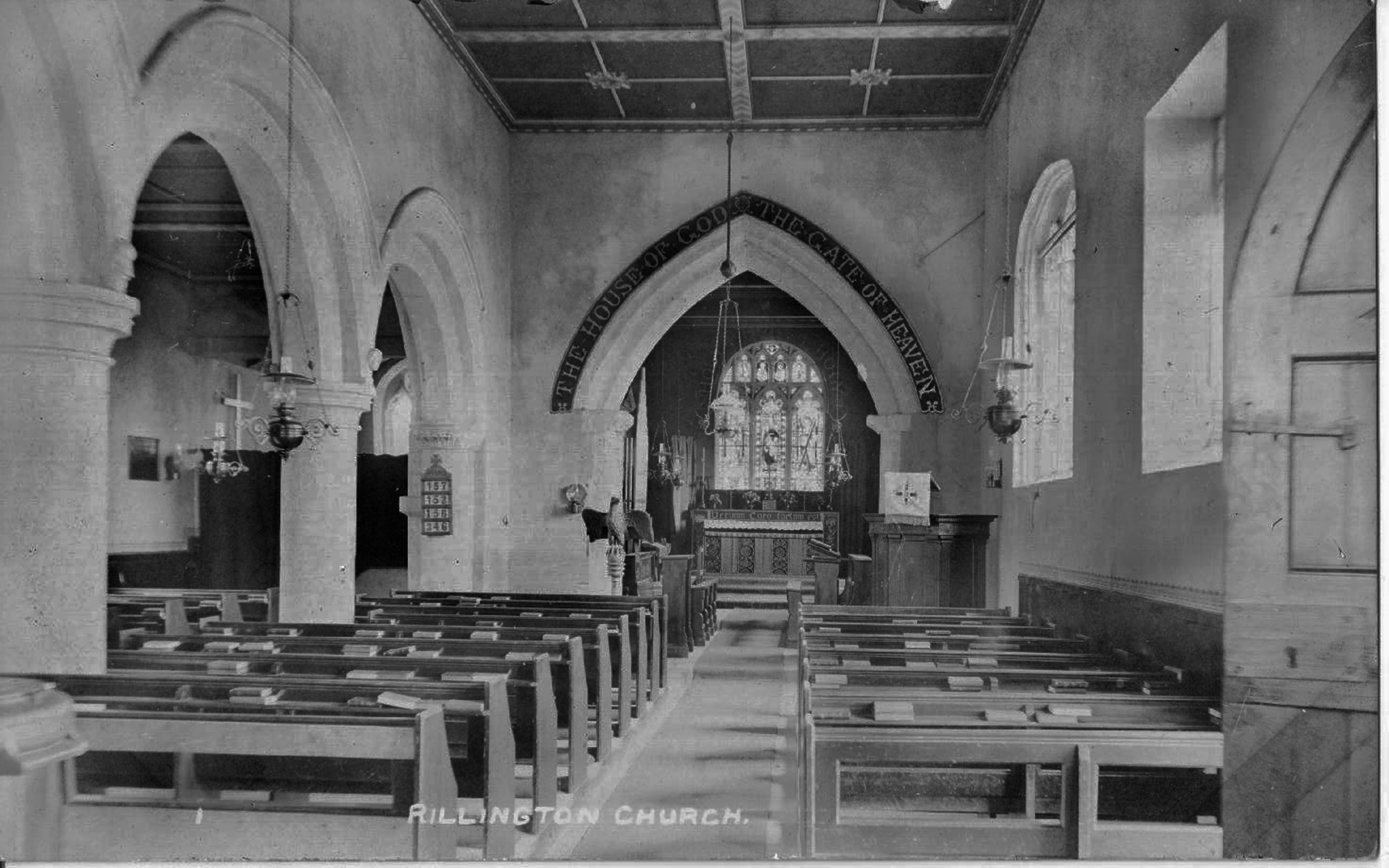
Beda Hazlewood
Beda Hazlewood first caught my attention through an entry recording her excommunication. Following her through the Rillington registers brought me to her children, her marriage and a life that ended much sooner than I had expected. What began with an unusual entry gradually became the story of a woman whose life we can glimpse, although we cannot hear her own account of it.
Writing about someone’s family history calls for care, particularly where the surname remains familiar in the village. Some of the language quoted here belongs to the eighteenth-century records and can sound harsh today. I have retained it where it helps explain the entries, while remembering how little they tell us about Beda’s circumstances or feelings.
On 19 June 1766, Beda, daughter of Michael and Sarah Hazlewood, was baptised at Rillington. The entry gives us her parents and a starting point, although it does not tell us her date of birth.
Following the name
Even her surname requires a little attention. The printed index gathers Hazlewood, Hasslewood, Hazzelwood, Hazzlewood, Hezlewood and Hezzlewood under one heading. Beda herself appears as Hazlewood and Hezlewood in the entries examined here, before becoming Cook on marriage.
This is familiar territory for one-name researchers: a search under one spelling can miss a person altogether. The index offers possible routes through the records, but names, dates and family connections still need checking. A shared surname, whether in an old register or in the village today, does not by itself establish a relationship.
A mother in the register
On 14 October 1787, the baptism register recorded “William bastard son of Beda Hezlewood”. No father was named in the entry.
The wording is blunt to modern eyes. “Bastard”, “base born” and, in some contexts, “natural son” or “natural daughter” were terms used to describe children born outside marriage. Their meaning needs to be considered in context. Here, the wording tells us how William’s birth was classified, but very little about his parents’ relationship or the circumstances in which Beda became a mother.
Excommunication and penance
In 1789, Beda’s name appeared beside that of Thomas Nicholson when their excommunication “was published in the Church of R”. The appendix to the printed registers dates this to 17 April/May, leaving the month uncertain.
Excommunication excluded a person from participation in the sacraments. The entries examined here do not state why Beda was excommunicated, so that question must remain open.
Nor does Thomas Nicholson’s appearance beside her establish that he was William’s father. His relationship to Beda remains unknown: the register records the announcement of a sentence, without the court proceedings that might explain it.
On 24 October 1790, the register tells us that “Beda Hezlewood did Penance”. Three weeks later, on 14 November, her absolution from the sentence of excommunication was read in Rillington church. Both events are recorded, but there is no description of the penance she performed.
The vicar and the parish
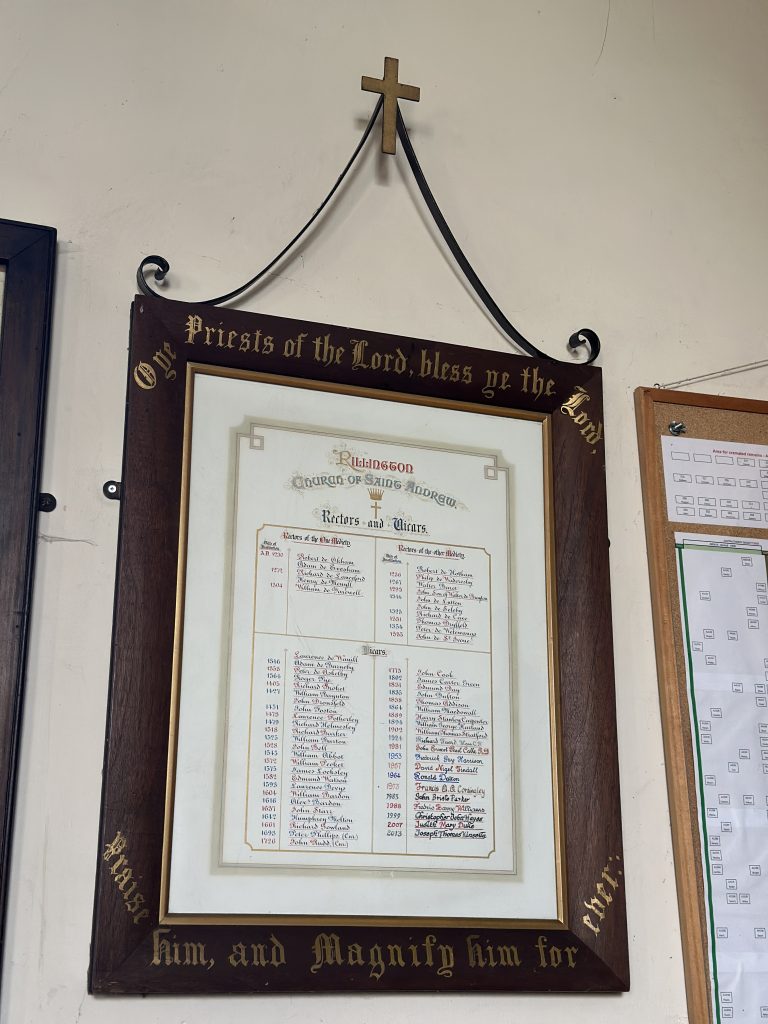
John Cook was vicar during these years. His work brought him into parishioners’ lives at baptisms, marriages and burials, while announcements of excommunication and absolution also formed part of parish life. These entries place church discipline alongside the familiar occasions recorded in the registers.
We cannot recover Cook’s private attitude towards Beda, but the registers remind us that his own family experienced loss too. His wife Mary was buried on 11 November 1789, during the period between Beda’s excommunication and her absolution the following year.
Marriage and a growing family
Beda’s next recorded child was John, baptised on 5 March 1792 and described in the same terms as William. Again, the entry names no father. It adds another child to her story, but gives us no account of her relationship or how she supported her family.
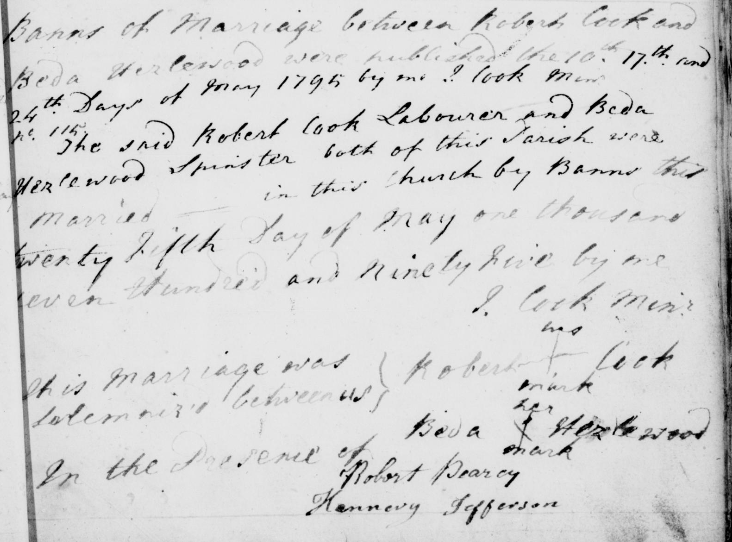
On 25 May 1795, she married Robert Cook, a labourer. Both were described as belonging to the parish, and Beda was recorded as a spinster. The banns had been read on 10, 17 and 24 May. John Cook conducted the marriage, witnessed by Robert Pearcy and Henry Jefferson; the shared surname does not establish a family connection between the vicar and the groom.
Both bride and groom made their marks, which can be seen in Figure 2. Among entries written about Beda by others, her own mark offers a particularly personal connection.
In 1796, Robert, son of Robert and Beda Cook, was baptised. The printed transcript notes that this entry does not appear in the bishop’s transcript, a reminder that surviving versions of a register do not always contain exactly the same information.
The final entries
On 12 June 1797, Beda, wife of Robert Cook, was buried at Rillington. Almost thirty-one years had passed since her baptism, and just over two since her wedding. The entry gives no cause of death.
Two infant burials may also belong to this family. William, infant son of Robert Cook, was buried on 4 April 1797, although his mother is not named and his connection to Beda remains unconfirmed. On 23 April 1798, Robert Cook, infant son of Robert Cook, labourer, was buried. He may have been the child baptised to Robert and Beda in 1796, but the burial entry alone does not establish that identification.
If both children belonged to this household, Robert lost his wife and two young sons in little over a year. These entries suggest possible family losses, but they do not establish a connection between Beda’s death and childbirth.
I have not securely identified Thomas Nicholson, traced Robert Cook’s later life or established what became of Beda’s older sons. Even with those gaps, the registers give us a life worth remembering. Beda was a daughter, a mother and a wife, as well as a woman subject to ecclesiastical discipline. Her mark survives in the marriage register; her own account of her life is what I would most like to have found.
Sources and acknowledgement
Litton, Pauline, M., The Parish Registers of Rillington and Scampston, 1638-1837, Vol: 179 of Publications of the Yorkshire Archaeological Society, Parish Register Section (2012) pp. 99, 114–116, 118, 121–123, 145, 231 and 255.
The marriage register image, PR/RIL/4, p. 75, was accessed through Findmypast and is reproduced with permission of the Borthwick Institute for Archives, University of York, granted on 22 October 2026.