
A Helping Hand and a Feast Day: Rillington’s Friendly Societies
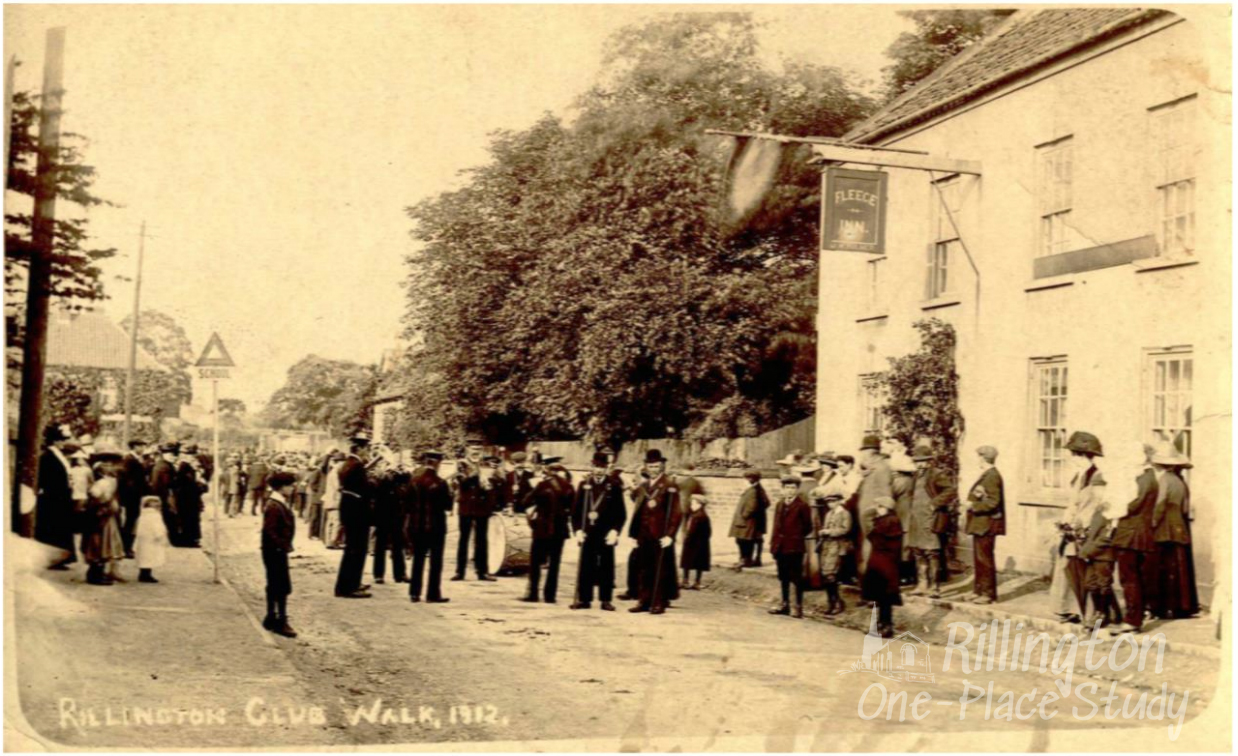
In this photograph of Rillington’s Club Walk in 1912, Westgate has been taken over by the occasion. Villagers line the road outside the Fleece Inn, while the men at the centre wear the collars and regalia of their society. It looks like a village celebration, and it was, but behind the procession lay something much more serious.
Long before the modern welfare state, illness could bring a family’s income to an abrupt halt. There might also be a doctor to pay and, if the worst happened, the cost of a funeral. For working people with little money to spare, a friendly society offered a measure of protection. Members made regular contributions to a common fund from which payments could be made during sickness or following a death. It was mutual support rather than charity; members helped one another in the hope that the same help would be there when they needed it.
Rillington had several such societies. By the later nineteenth century, three of them held their annual club feasts together, filling the village with processions, brass bands, regalia, speeches, dinners and visitors. The revelry was the public face of organisations whose ordinary business was conducted rather more quietly in club rooms and village inns.
Rillington’s lodges
The earliest identified lodge was Court St Quintin of the Ancient Order of Foresters, No. 1180, founded in 1841. It had 63 members in 1843, rising to 104 in 1860 and 150 in 1870, when its funds stood at £592. By 1884, membership had reached 180. The St Quintin name linked the society firmly to one of Rillington and Scampston’s leading landowning families.
An Independent Order of Druids lodge had been founded in Rillington by 1868. In 1877 it had 216 members and funds of £727; seven years later it still had 200 members, with £506 in its fund. Dr Thomas Allanson had been an early member. When he was buried in St Andrew’s churchyard in 1871, his bearers were fellow members of the Order of Druids. Their presence at his funeral was a practical demonstration of fellowship continuing to the grave.
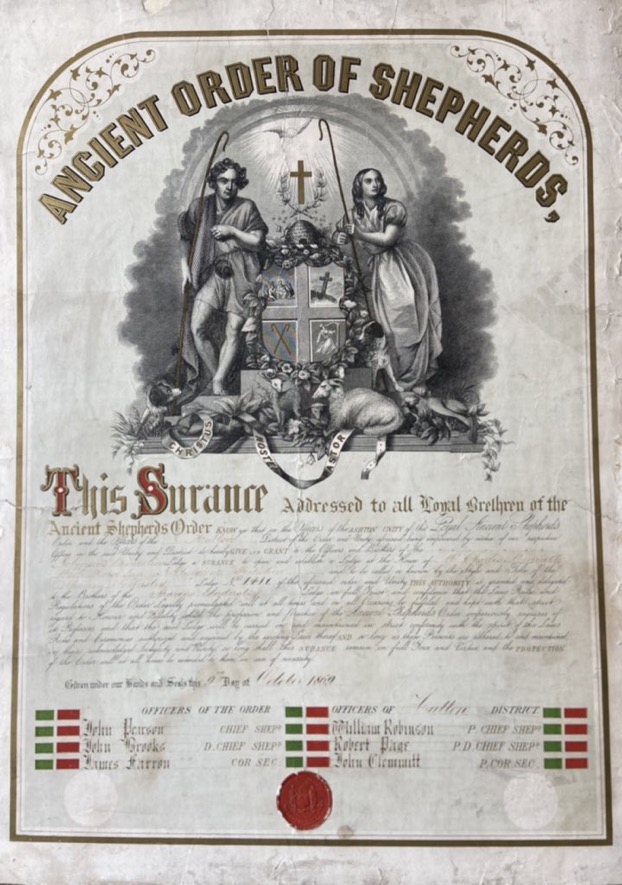
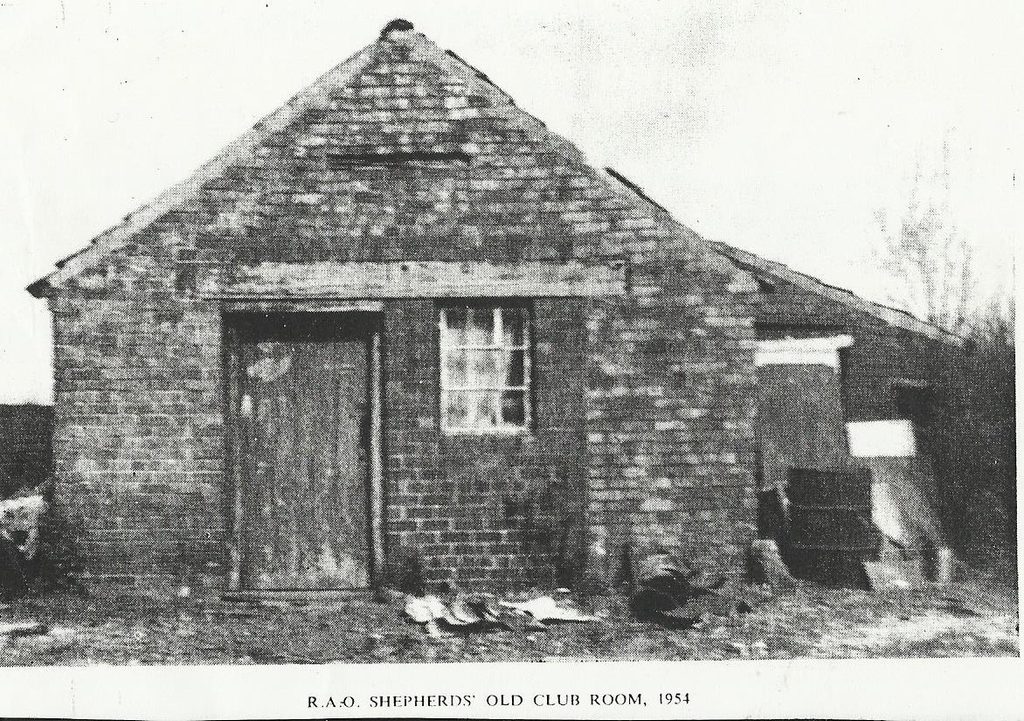
Spavin’s Industry Lodge of the Loyal Order of Ancient Shepherds, No. 1411, followed in 1869. It had 75 members in 1884. After leaving the parent order, it rejoined in 1912 as Spavin’s Industry Lodge No. 2698. The lodge was still thriving in 1946, when its 110 members had accumulated funds of £1,528. Its former club room survived long enough to be photographed in 1954: an unassuming brick building that had once housed the lodge’s meetings and business.
A Rillington United Friendly Society is also known to have existed in 1926, although its foundation date has not yet been established.
There is one unresolved wrinkle in the evidence. The published lodge directory states that Court St Quintin left the Foresters in 1876, yet a newspaper report ten years later still described it as “Court St. Quintin of the Ancient Order of Foresters 1180”. It may have continued independently while retaining its familiar name and number, or the directory date may require correction. For the moment, the precise status of the lodge after 1876 remains uncertain.
Fourpence a week
The Malton Messenger provides a rare glimpse inside the accounts of Rillington’s societies. At the Druids’ annual feast in 1886, the vice-chairman explained that members paid 17s. 4d. a year—exactly 4d. a week. If a man were ill for a fortnight, he said, he would receive the equivalent of his entire annual contribution. He also recalled men who had left the club believing that they would never require assistance, only to discover their mistake when need arose.
The Druids’ balance sheet shows where the money went. During the preceding year, £97 3s. 8d. had been paid to sick members, £48 towards funerals and £28 10s. to the surgeon. The society also spent £16 17s. 6d. on its annual dinner, £3 on music and £4 10s. on its officers’ salaries. After total expenditure of £202 16s. 7d., it retained a balance of £521 4s. 6d.
These were not abstract sums. The speaker reminded those present that members had been thankful for help during sickness and that the fund had “gladdened many a widow’s heart”. It was better, he said, to help one another in this way than to apply to the guardians for relief. That sentence goes to the heart of the friendly-society ethos: provision, independence and the avoidance of the Poor Law.
Court St Quintin’s accounts tell a similar story. In 1886 it spent £101 4s. on sick members, £27 on funerals and £24 on the surgeon. A further £15 12s. 6d. paid for the dinner. Despite what was described as a heavy year, the society had £641 17s. 2½d. in hand.
The Shepherds operated on a smaller scale but offered the same kinds of support. Their expenditure included £12 1s. 8d. for sickness, £7 4s. as a death allowance and £7 19s. for the doctor, as well as £7 4s. 5d. in feast expenses. At the end of the year, the club held £165 4s. 7d.
The dinner and music appear beside sickness, medical attendance and funerals in the accounts because both sides of club life mattered. The societies existed to provide financial assistance, but fellowship helped to bind their members together and encouraged them to keep contributing year after year.
Rillington Club Feast
The Malton Messenger described the village feast as “one of the chief days of the year in the Rillington calendar”. On Thursday 1 July 1886, fine weather drew large numbers of people from the surrounding district. The three societies first met separately at their headquarters to conduct their ordinary business. They then attended church before sitting down to dinner.
The Druids assembled at the Fleece Inn. Led by Rillington Brass Band, they marched to the parish church, where the Revd F. Porter, vicar of Yedingham, preached. The band played them back to the Fleece, whose entrances had been decorated for the occasion. Mr and Mrs Plews provided a “first-class spread” in a large tent behind the inn for nearly 150 members and invited guests. Speeches and toasts followed, including one to the prosperity of the club and another to the surgeon, Mr Clapham.
Court St Quintin met at Mr N. Harrison’s Coach and Horses Inn. The Foresters processed behind Thornton Old Band to Scampston Church, where the Revd T. Williams preached from Proverbs 6:6: “Go to the ant, thou sluggard.” On their return, they dined in another tent at the specially decorated inn. Among those toasted were W. H. St Quintin, W. H. Huddleston, H. O. Piercy and Dr Marsden, bringing together several names familiar in the history of Rillington and Scampston.
The Shepherds also conducted their business before walking to Rillington Church behind the Flaxton Rifle Band in uniform. They returned to the Coach and Horses for dinner in a tent, with the Revd George Greenside presiding and the Revd J. Bennett acting as vice-chairman. One of the lodge’s secretaries, James Cook, presented its annual report.
At about teatime, the three clubs came together and paraded through the village, each headed by its band and the members wearing their regalia. The evening was given over to a cricket match and sports, while Rillington Band played in the tent behind the Fleece. Business, worship, dinner and entertainment all had their allotted place.
The arrangement was repeated. In June 1888, the Malton Gazette explained that, although the three societies belonged to different orders, they usually arranged for their anniversaries to fall on the same day. This gave the event greater importance and brought a large influx of visitors, as friends of Rillington families returned to the village for the festival.
The Coach and Horses was described as the centre of attraction, but the Fleece also had a substantial company to feed. Neither inn was large enough to accommodate all its guests, so meals were served in marquees erected outside. After bands had formed at the club headquarters, processions went to Rillington and Scampston churches. The clubmen also marched around the neighbourhood making “friendly calls” upon the principal farmers. Rillington’s streets were full of entertainment, and villagers were joined by visitors from Malton and the surrounding district.
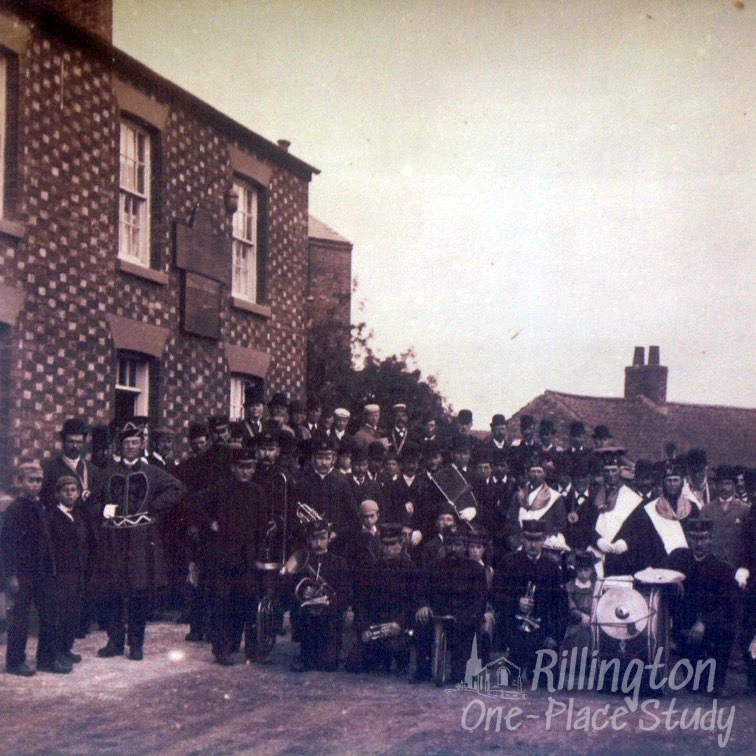
The photographs bring the newspaper descriptions to life. In the 1912 Club Walk, officials wearing their collars stand in Westgate outside the Fleece while men, women and children crowd the roadside. In another image, a large company poses with its brass band outside the Royal Oak on Low Moorgate. The bands were not a decorative afterthought. They announced the societies’ presence, accompanied members through the village and turned the annual meeting into a public occasion.
The women who provided for themselves
Friendly-society provision in Rillington was not confined to men. The village also had a Female Interment Society, whose name indicates its particular concern with provision for burial. Its surviving rules and contribution rates have not yet been found, but a report in the Malton Gazette records its annual meeting on Holy Thursday in 1866.
Members assembled at the parish church at two o’clock, where the Revd W. MacDowall preached. After the society’s report had been read and its business completed, the women marched to the Coach and Horses to enjoy the “cup that cheers but not inebriates”, supplied by the host and hostess in a large tent.
The newspaper correspondent observed that friendly societies were usually entertained by a brass band at their festivals. On this occasion, the women apparently provided their own instrumental entertainment. His account ended with a decidedly patronising joke about some of them playing out of tune and in so high a key that “the music of the sisterhood was completely drowned”. Beneath the reporter’s humour, however, is evidence of women organising their own society, electing officers, scrutinising its accounts and making provision for death and burial.
More than a day out
The club feast was undoubtedly a highlight of Rillington’s year, but the processions, bands and dinners should not obscure the purpose behind them. Every fourpence paid into the common fund represented an attempt to prepare for illness, medical expense or death. Every payment to a sick member or bereaved family showed that the system could work.
Friendly societies occupied a space between dependence upon the Poor Law and the state provision that developed during the twentieth century. They allowed members to retain a measure of independence while belonging to something larger than themselves. The collars and banners expressed pride in that membership; the balance sheets demonstrated its value.
When Dr Allanson’s coffin was borne by his fellow Druids, the principle became visible in its simplest form. These were societies whose members contributed together, celebrated together and, when the time came, carried one another.
Sources
East Yorkshire Local History Society (n.d.) ‘The Private Lunatic Asylums of the East Riding’. Available at: https://www.eylhs.org.uk/ (Accessed: 12 September 2026).
Malton Gazette (1866) ‘Rillington: Female Interment Society’, 19 May, p. 4.
Malton Gazette (1888) ‘Rillington: Friendly Societies’ Demonstration’, 30 June, p. 2.
Malton Messenger (1886) ‘Rillington Club Feast’, 3 July, p. 3.