
Where the Poor Found Shelter
Source: Author’s archive
Today, there is little in Low Moorgate to suggest that this quiet corner of Rillington once played an important part in the administration of poor relief across a wide area of East Yorkshire.
The building remembered as Rillington Workhouse has been demolished. Nearby cottages have disappeared or been replaced, and the name Union Place may no longer appear in any modern address. Yet maps, parish registers and one surviving photograph allow us to reconstruct something of what once stood here, and of the people who depended upon it.
Before the Gilbert Union
For centuries, responsibility for relieving poverty rested largely with individual parishes. Overseers of the Poor collected rates and used the money to assist those unable to support themselves.
Rillington’s parish registers give brief but telling glimpses of this earlier system.
In 1793, William Banks was buried as “a very poor man at the Expence of the Town”. Ann Medd was described as “a very poor woman” whose burial was paid for by the Overseers. Other entries record people living in the “Town’s House”, the “poor House” or “one of the poor Houses”.
These were not incidental descriptions. They show that Rillington possessed accommodation for people dependent upon parish relief well before the nineteenth-century workhouse system developed.
The registers also contain baptisms of children described in the language of their time as “bastard” or “base born”. Some mothers were living in the Town’s House or Poor House. Such entries are stark reminders that poverty, illegitimacy, illness and insecure housing were often closely connected.
Rillington at the centre of a union
Gilbert’s Act of 1782 allowed neighbouring parishes to combine to provide accommodation for their poor. Unlike the later Victorian workhouse system, Gilbert Unions were principally intended to house children, the elderly, the sick and infirm. Able-bodied people were generally to be found work outside the institution.
By 1821, Rillington Poor House had become the centre of a Gilbert Union comprising more than fifty parishes. Its reach extended from Skirpenbeck, near York, to Gristhorpe, near Filey. Rillington was therefore not merely providing for its own inhabitants. People could be sent here from communities spread across a considerable rural area.
The Rillington baptism register reflects this wider role. During the 1820s, numerous children were baptised whose mothers were recorded as single women “of RPH” aka Rillington Poor House.
Among them were:
- George, son of Jemima Stonehouse, in 1823
- Eliza, daughter of Rachel Ostler, in 1821
- Hannah, daughter of Elizabeth Barnes, in 1825
- Jane, daughter of Sarah Midgley, in 1826
- James, son of Mary Cordukes, in 1827
- Moses, son of Mary Dobson, in 1827
- Aaron, son of Elizabeth Wiles, in 1827
These women do not appear to have remained in Rillington. Many may have belonged to one of the other parishes within the union and may have been temporary residents of the Poor House. That remains an interpretation rather than a proven fact, but it would explain why their names rarely become established village families.
One entry also guards against making assumptions from surnames alone. Enos Piercy was baptised in 1823, the son of the unmarried Mary Piercy, but he was not described as being of Rillington Poor House. The Piercys were an extended Rillington family, and a familiar surname does not necessarily indicate residence in the institution.
What stood in Low Moorgate?
The precise development of the site is not entirely straightforward.
The 1848 tithe map identifies Plot 309 as “Cottages & Garden”. The property belonged to the Overseers of the Poor of Rillington and was occupied by William Bielby.
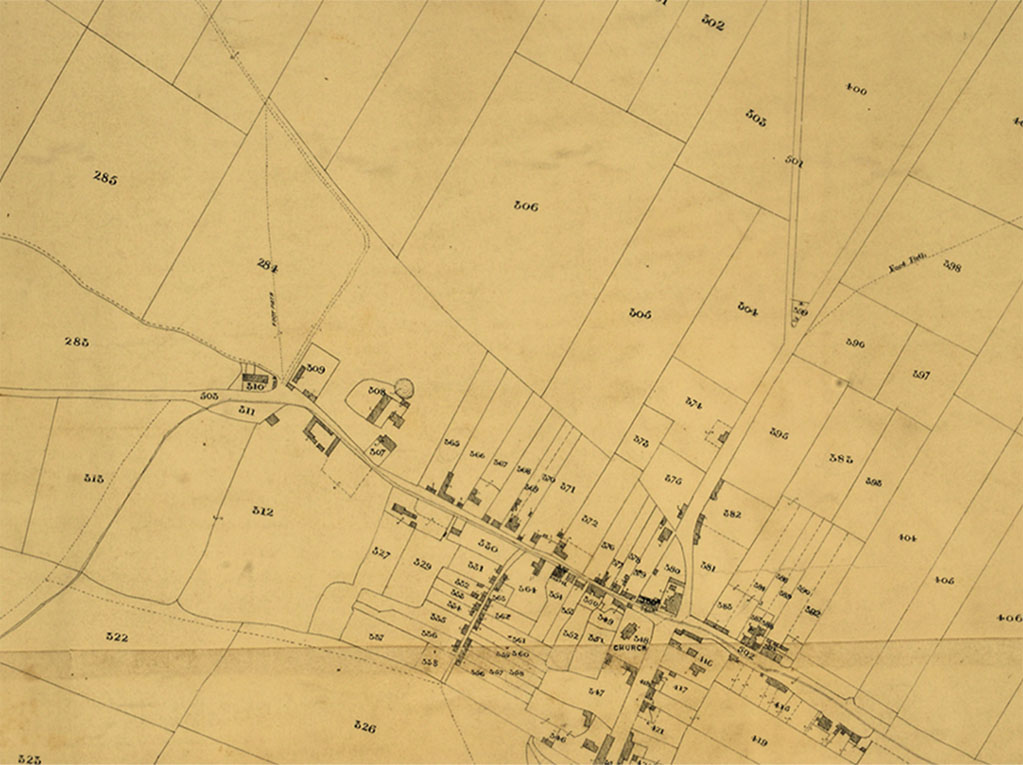
Image supplied by The National Archives.
The wording is significant. It does not describe the property simply as a workhouse. It suggests a group of parish-owned cottages and associated land.
William Bielby was not listed as a workhouse governor or master. In the 1851 census he was a 52-year-old agricultural labourer living with his wife, Charity, and their children in Low Moorgate. He may therefore have occupied one of the Overseers’ cottages as an ordinary tenant or resident.
Parish-owned cottages were not always used exclusively to accommodate institutional inmates. They could be let to poor labouring families or used flexibly according to local need. Mitchelson noted that many East Yorkshire parishes owned cottages for this purpose.
The neighbouring tithe plots help locate the site precisely:
- Plot 309: cottages and garden belonging to the Overseers
- Plot 310: the Royal Oak
- Plots 307 and 308: Rectory Farm
- Plot 312: Park Farm
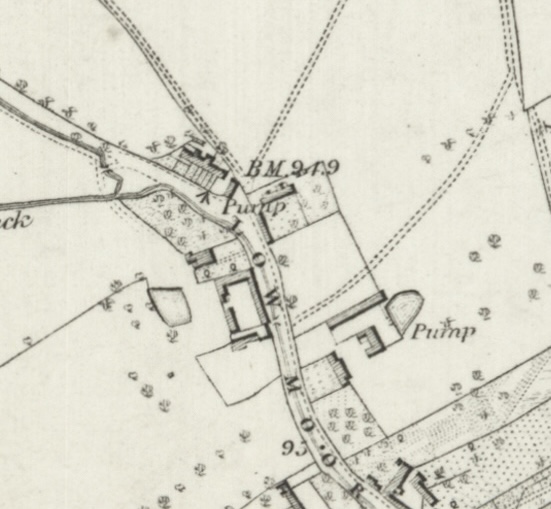
The 1854 Ordnance Survey map shows a collection of buildings near the benchmark marked BM 249, at the northern end of Low Moorgate. These appear to occupy the same general area as the Overseers’ property shown on the tithe map, although the map does not allow us to say with certainty that every building remained unchanged.
After the 1834 Act
The Poor Law Amendment Act of 1834 introduced a more centralised system based upon larger Poor Law Unions administered by elected Boards of Guardians.
Rillington’s Gilbert Union did not fit neatly into this new structure. Its functions were eventually absorbed by the Malton Poor Law Union, and the main institutional provision for the district moved elsewhere.
This did not mean that the Low Moorgate site immediately ceased to be associated with poverty, old age or infirmity. Buildings could survive long after the administrative system that created them had changed.
Nigel Hudleston recorded that an old infirmary block adjoining the poor cottages bore the date “Union Place, 1849”. He also remembered local people referring to the residents of these cottages as living “on the flags”, from the paved causer in front.
That phrase endured in local speech. Older villagers still spoke of people living “on the flags” near Union Place. In Yorkshire, a causer or causey was a paved way or pavement; a word familiar far beyond Rillington.
Hudleston also placed houses for “poor, old and infirm folks” on the uneven ground below the Royal Oak and above the infirmary block. His description suggests not one isolated building but a small group of cottages and associated accommodation occupying both sides of this part of Low Moorgate.
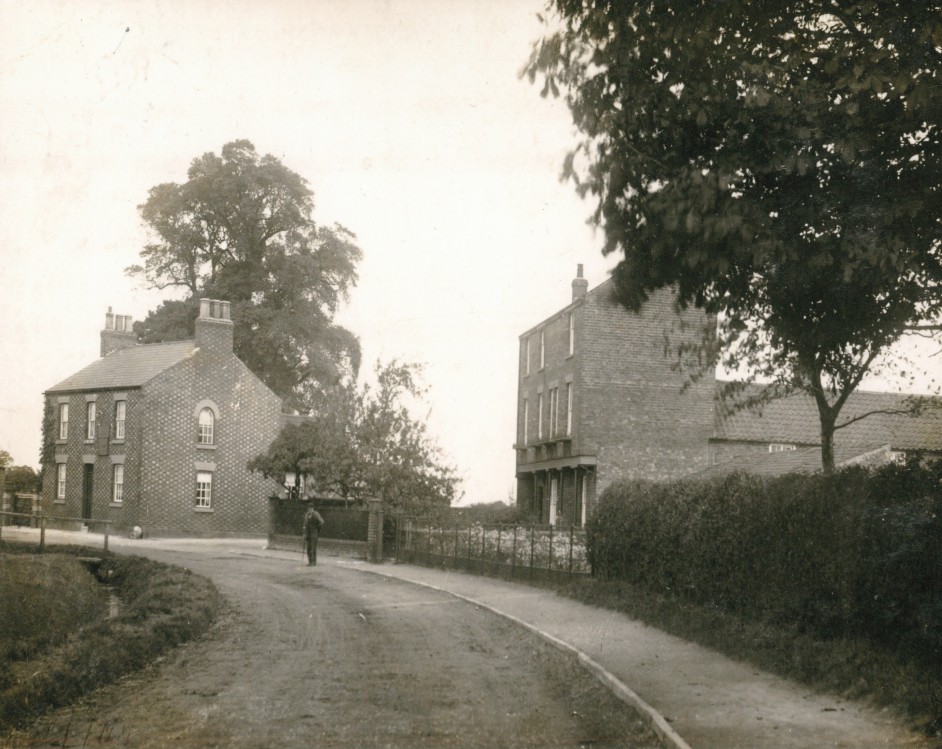
A rare postcard preserved by East Riding Archives provides a valuable view along Low Moorgate.
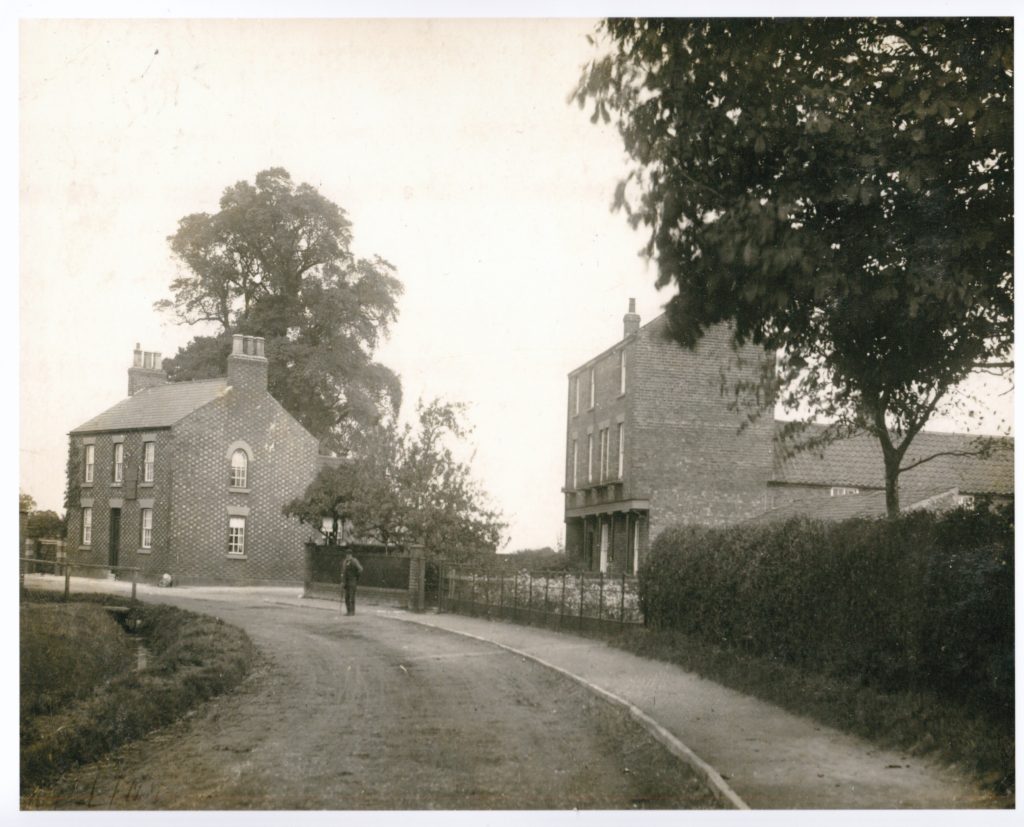
Reproduced by permission of the East Riding Archives, Beverley
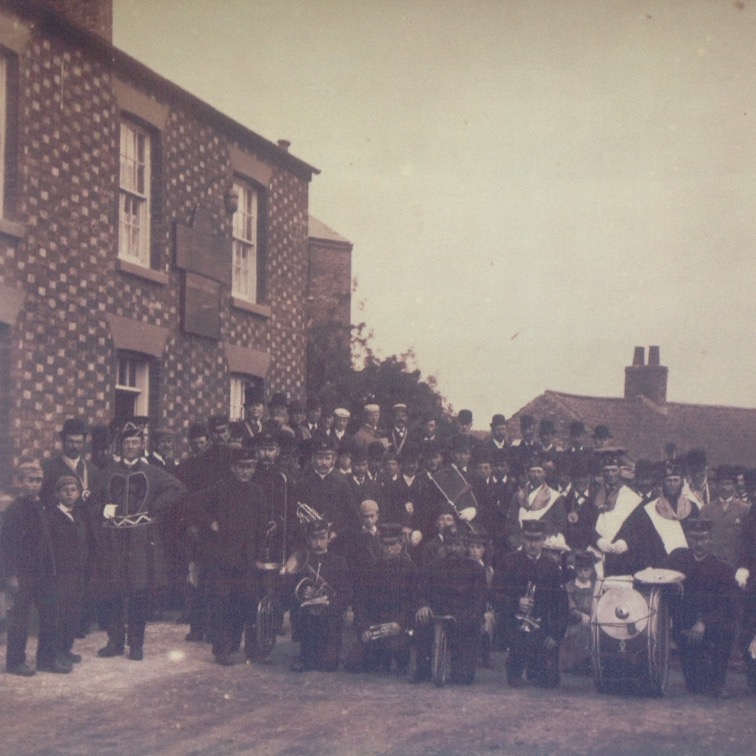
The Royal Oak stands on the left, displaying the distinctive two-tone Flemish bond brickwork still associated with Rillington’s nineteenth-century brickmaking. On the right stands the building remembered as the former workhouse, now demolished.
The photograph may show a structure altered or rebuilt after the earliest maps were surveyed. At present, the evidence is insufficient to establish whether it was exactly the same building shown in 1848 or part of the later development known as Union Place. It remains, however, an important visual record of a site whose appearance has otherwise been largely lost.
It began with parish officers paying for burials, distributing cash and providing shelter in the Town’s House and poor houses. It developed into a Gilbert Union serving more than fifty parishes. After the reforms of 1834, the formal administration moved elsewhere, but cottages, an infirmary and the name Union Place preserved the site’s association with poverty and dependence.
The parish registers supply the names. The 1848 tithe map identifies the property, while the 1854 Ordnance Survey map helps locate it within the village landscape. Hudleston preserved local memory, and a rare postcard preserved by the East Riding Archives shows something that has now disappeared.
Stand in Low Moorgate today and little of this history is immediately visible. Yet once the maps and records are brought together, this ordinary stretch of road becomes a landscape of parish responsibility, institutional change and individual lives.
The workhouse has gone, but the people who passed through Rillington Poor House have not vanished entirely. Their presence remains in a clerk’s brief notation: “single woman of RPH”, “a very poor man”, or “at the Expence of the Overseers.”
Sometimes, those few words are all that survive.